


CTO and Co-Founder Andrew Bacon shares the hard but fundamental lessons learned from six years of building spacecraft.
Andrew has seen friends lose satellites within their first orbit due to poor thermal design — in one case, a last-second decision not to apply Multi Layer Insulation (MLI) to a panel because it wasn’t adhering properly proved fatal to the mission.
The internet has recently been awash with debate about whether orbital data centres will overheat without massive radiators, given there is no air in space to carry heat away. This is true — but it is not a new problem, and large radiators have a literal dark side.
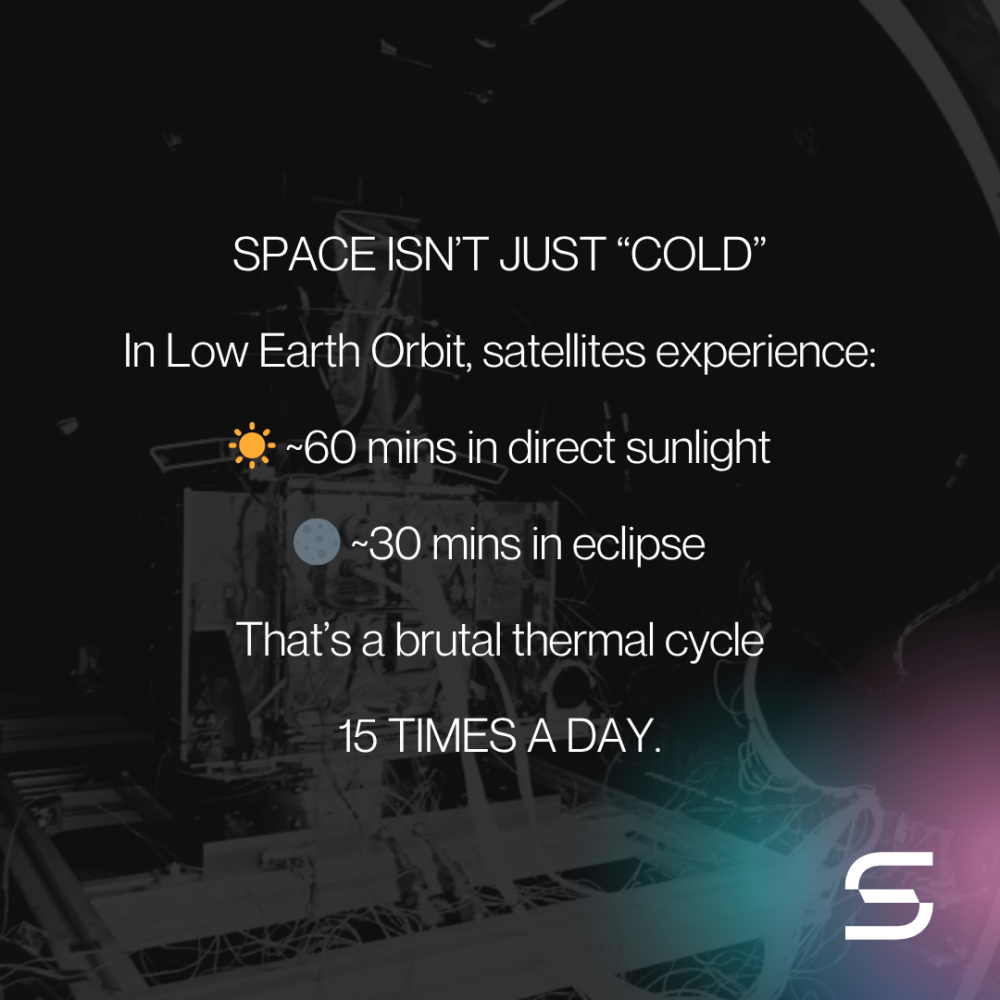
In Low Earth Orbit (LEO), a satellite typically spends around 60 minutes in sunlight and 30 minutes in eclipse. As Andrew puts it: it is not unlike taking your satellite out of the oven and putting it straight into the freezer — then back into the oven — fifteen times a day, five thousand times a year.
A well-designed satellite maintains internal temperatures between +10°C and +30°C. A poorly designed one can swing below -20°C and above +60°C. Lithium batteries lose capacity below 0°C. Electronics failure risk often doubles for every 10°C above room temperature. Aluminium structures can expand and contract by 0.5% per orbit — enough to crack housings, break electrical contacts, and misalign telescope optics.
Balancing the hot case (sunlight) and cold case (eclipse) is the primary challenge for thermal engineers, particularly on high-power satellites. The tools: carefully varied ratios of absorbing to reflecting paint, internal heaters, and MLI blankets.
Most critically: Conduct a thermal vacuum test where the satellite is put into an air evacuated chamber that can rapidly heat up and cool down to simulate multiple complete orbits. It is not mandatory. But skipping it is a significant gamble with a multimillion-dollar asset.
Radiation, micrometeorites and vibration will follow in future posts. Post-launch, however, nothing kills a satellite faster than bad thermal design.
Here endeth the lesson. Ignore at your peril and/or leisure.
Source: Forged in Space: Lessons From a Founder 2/1000
https://www.linkedin.com/pulse/forged-space-lessons-from-founder-21000-space-forge-ltd-ggtme