


As launch costs fall and access to orbit becomes routine, the space industry faces its next defining challenge: movement once spacecraft reach orbit. Impulse Space is addressing this gap as an orbital infrastructure company: providing cheap, fast, customizable, and reliable transportation across orbits—and investment capital is following the opportunity at scale.
The numbers tell the story. A $300 million Series C one year ago achieved unicorn status. Now, a $500 million Series D led by 137 Ventures and BANNER VC brings total funding to over $1 billion, with the company valued at $4.26 billion. Impulse founder and CEO Tom Mueller, who led propulsion development at SpaceX for many years, is scaling a company that the market increasingly views as foundational space infrastructure.
Satellites seeking to reach Geostationary orbit (GEO) face two imperfect choices: use onboard electric propulsion, fuel-efficient but requiring several months, or launch directly to their final destination, which is faster but rare, expensive, and dependent on heavy-lift rockets that limit flexibility. There is also the risk of delivery to the wrong orbit entirely. The recent Blue Origin launch illustrated this starkly: a second stage failure left AST SpaceMobile’s BlueBird #7 stranded in a low orbit from which its station-keeping propulsion cannot recover. The satellite is lost—and could have been saved with Helios.
This mobility bottleneck is holding the space economy back. Impulse Space is building two complementary vehicles to solve it.
Mira serves as the precision orbital service vehicle—enabling maneuvering, repositioning, and targeted deployment of up to 300kg across LEO, MEO, and GEO. The team took the first Mira vehicle from clean sheet to in-space operations in just 14 months. Since 2023, two customer-based missions have launched successfully.
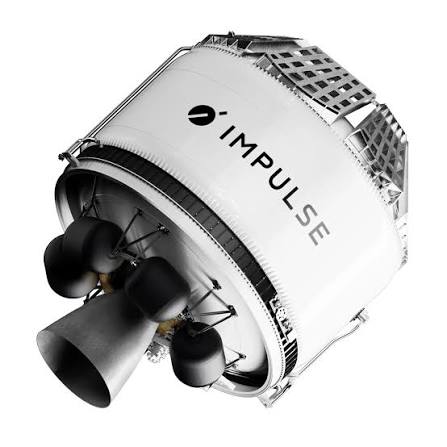
Helios is a high-energy kick stage capable of delivering up to five tons to GEO in eight hours, compatible with both medium- and heavy-lift launch vehicles—improving access to distant orbits by an order of magnitude. First flights are now scheduled for 2027, with GEO rideshare missions to follow.
With contracts spanning NASA, the Defense Innovation Unit, and commercial partners including Vast, Anduril Industries, and Orbit Fab, Impulse Space is validated its technology through operational missions. At $4.26 billion, the market is sending a clear signal: reliable movement between orbits is foundational infrastructure for the space economy and Impulse Space is building it.
Image Credit: Impulse Space – Helios spacecraft
References
Impulse Space Raises $500M Series D to Build In-Space Mobility Infrastructure for the Space Economy
Impulse Space raises $500 million at $4.26 billion valuation as space investing surges
Impulse Space Secures $300 Million Series C to Accelerate the Future of In-Space Mobility https://www.impulsespace.com/updates/impulse-space-secures-300-million-dollar-series-c-to-accelerate-the-future-of-in-space-mobility
Building the Future of the Space Economy https://www.impulsespace.com/updates/building-the-future-of-the-space-economy
Blue Origin second stage failed to accurately deploy AST SpaceMobile BlueBird #7