


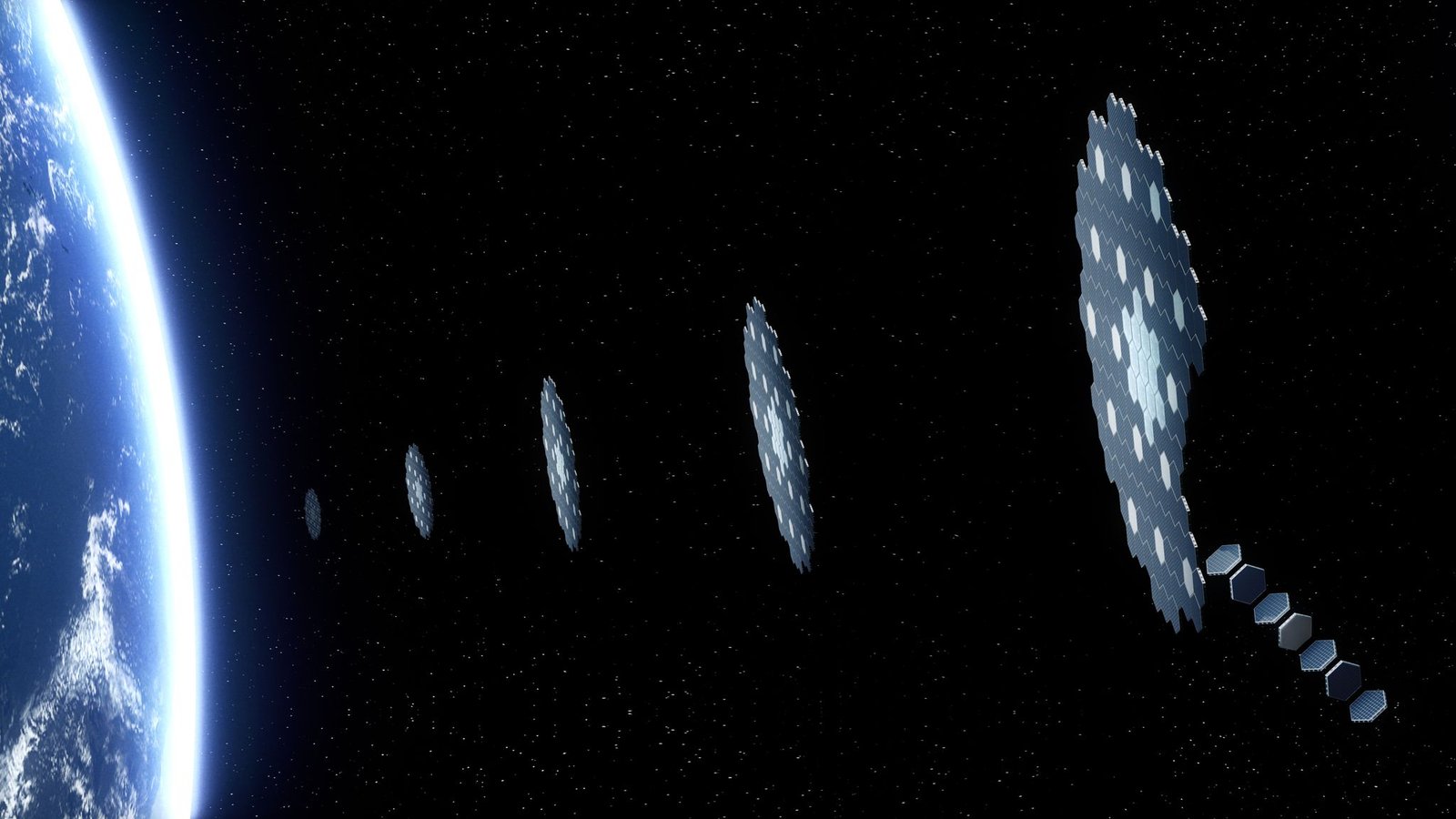
Rendezvous Robotics, the Colorado, USA based startup developing self-assembling spacecraft, announced $20M in seed funding today to support an in-space demo launching April 2028.
Too Big to Launch
Satellites are growing faster than the rockets that carry them. Manufacturers are now designing spacecraft with football-field-sized solar arrays and large-aperture antennas, and neither fits comfortably inside a launch fairing.
AST SpaceMobile has built the largest commercial spacecraft for its direct-to-device constellation, and it has to unfold once in orbit. Yet even larger spacecraft will be needed. Rendezvous Robotics is developing technology that lets future spacecraft launch in pieces and self-assemble in orbit.
How It Works
The company’s design is a series of roughly 1 m hexagonal tiles. Each carries sensors and onboard processing, and together they use electromagnetic fields to self-assemble in vacuum. Different tiles can serve as different satellite subsystems.
SpaceX Starship can dispense 100 tons of flat stacked payloads, which is a great way of getting a lot of payload into space for a large structure.
The technology was first conceived for large structures like astronaut habitats and pressurized space stations. In response to rising demand for large satellites, the company has narrowed its focus to satellites, for now.
The Road to Orbit
The tiles have already flown on zero-G aircraft flights, one suborbital mission and two missions to the ISS. In December, 32 tiles will head to the ISS to continue testing self-assembly inside the station. The funding supports an in-space demo in April 2028, when seven tiles will be tested in the vacuum of space for the first time. The goal is to show they can assemble, and reconfigure, into a single functional satellite.
Servicing, Not Just Assembly
Operators could change a configuration, add tiles or replace faulty parts. Today, servicing is largely limited to life extension, and a failed satellite often means building and launching a new one. The system could autonomously reconfigure into the next best available configuration when something is damaged or degraded.
Longer term, the company could stage tiles in an orbital depot and send out replacement parts on demand.
Why It Matters
The applications reach well beyond today’s satellites. Orbital data centers and orbital solar power structures are two examples where failed components could simply be swapped out. If the 2028 demo succeeds, launch size may stop being the limit on what we build in orbit.
Rendezvous Robotics Raises $20 Million to Build Spacecraft That Assemble Themselves in Orbit
Rendezvous Robotics Raises $20M to Develop Self-Assembling Spacecraft