


Thank you to CTO and Co-Founder of Space Forge, Andrew Bacon, who shares the hard but fundamental lessons learned from over six years of building spacecraft.
https://www.linkedin.com/pulse/forged-space-lessons-from-founder-space-forge-ltd-qdcme
Let’s start with a common misconception about the space industry: launch is not the biggest cost for commercial space missions. It’s not even the second biggest.
The cost of launch cost has fallen from around $20,000/kg to $7,000/kg — thanks largely to SpaceX — but the design, build and test of a satellite typically runs far higher:
- $50,000/kg for a tech demo (such as a cubesat)
- $300,000/kg for an operational mission (such as a weather satellite)
- $2,000,000/kg for an exploration mission (such as a Mars lander)
Of these costs, roughly half is labour, a quarter is materials, and a quarter is external services such as test facilities and insurance.
What is the biggest mistake start-ups make ?
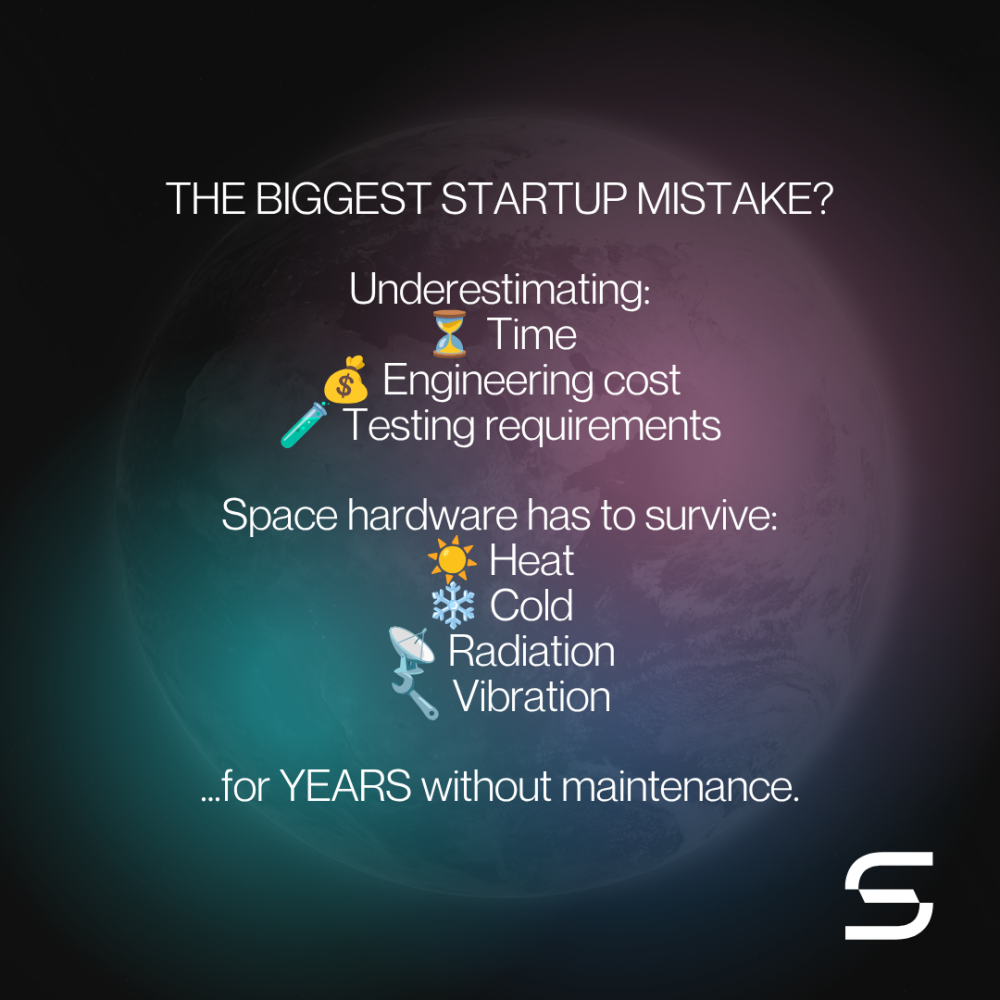
Designing something to survive 5+ years in orbit — without repair or maintenance — demands extensive upfront engineering and testing. Get it wrong, and the spacecraft may fail in its first orbit, or shortly after.
So what does this mean in practice?
Underestimating the time and cost of satellite design remains the most common pitfall for space startups entering the sector.
How can this be fixed?
Mass production can realistically reduce costs by a factor of ten when manufacturing hundreds of repeat-build satellites, though that requires serious accumulated operational experience. The second approach is returnability. Space Forge is developing fully returnable satellites that can be brought back to the manufacturer for upgrade or repair when components fail — much like a car, aircraft, or submarine. In-orbit servicing and maintenance is emerging as a complementary path.
This matters because space is one of the only industries where multimillion-dollar, high-technology assets are routinely treated as disposable. That is an engineering and economic anomaly the sector can no longer afford to ignore. The companies building the infrastructure to change that are quietly laying the foundation for a more sustainable and commercially viable space economy.