


The European Space Agency’s (ESA) newly released Space Economy Report gives a comprehensive overview of the latest developments shaping Europe’s space sector. The focus of this extract is on Private Investment in Space.
The full report covers key trends and figures of the space sector in 2025, including public and private investment in space, space activity in terms of launches, mass launched, satellites launched, and the space industry’s revenues both upstream and downstream.
Private Investment in Space
Global Trends
Private investment in space ventures worldwide reached an all-time high of €11.7 billion in 2025, surpassing the 2021 peak which had been induced by the SPAC (Special Purpose Acquisition Company) bubble, and posting outstanding growth of 60% compared to 2024, with 324 deals recorded (compared to 279 in 2024).
This sharp increase was entirely driven by a surge in US activity, which grew 177% compared to 2024, with nearly €8 billion raised by US space ventures in 2025 compared to just below €3 billion in 2024.
As in previous years, Venture Capital (VC) remained the largest deal category in 2025, accounting for 62% of the total volume invested and posting year-on-year growth of 43%.
Key Trends in Europe
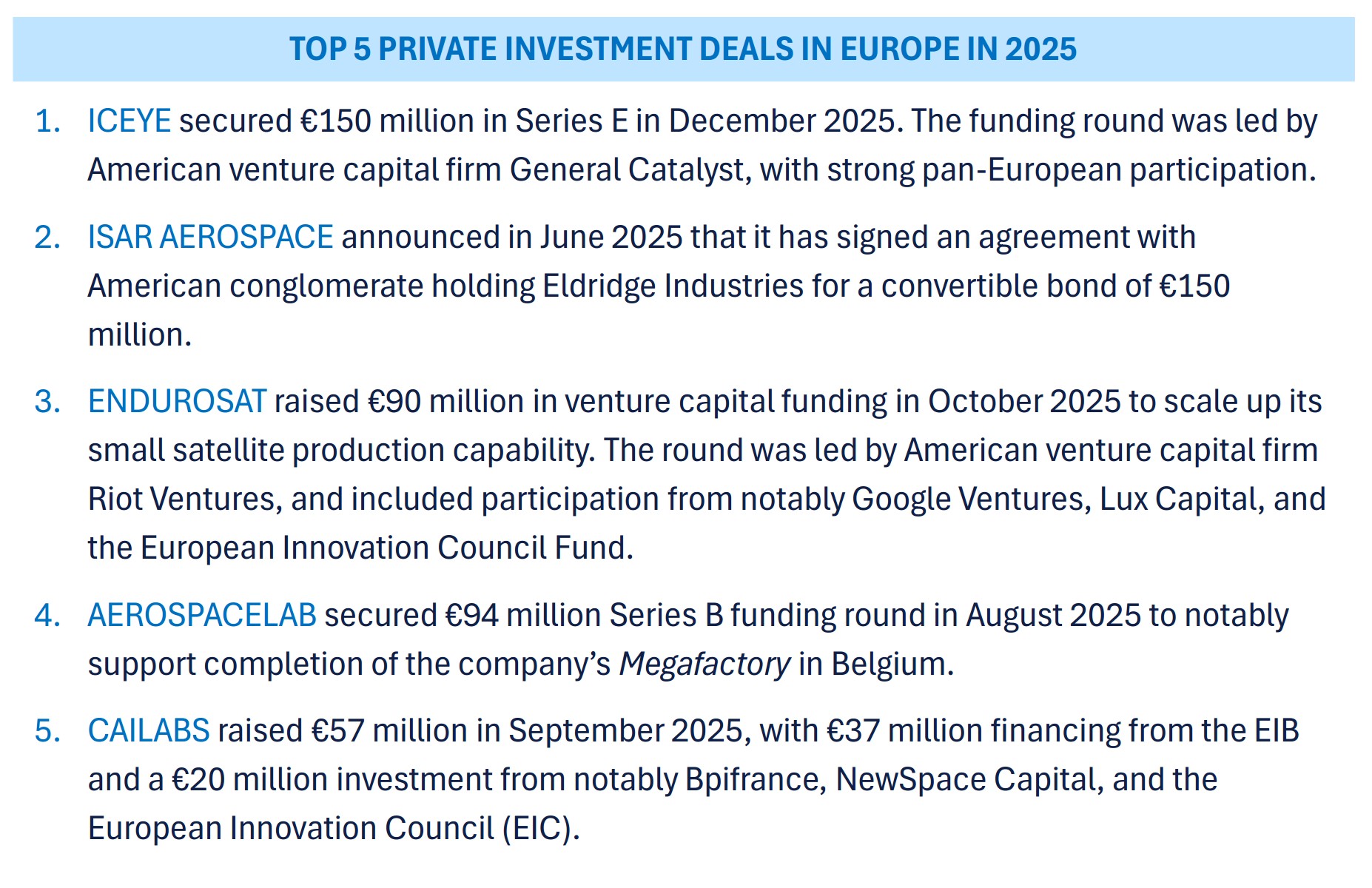
Space investment in Europe experienced a slight decrease in 2025, with European space ventures attracting just above €1.4 billion (-8% from 2024) through 88 deals recorded (-10% compared to 98 deals in 2024). Europe still posted the single largest average growth in the past five years, with a 37% CAGR (Compound Annual Growth Rate), compared to 17% in China and -2% in the US. It is also important to note that the volume of private investment in Europe in 2024 was boosted by the acquisition of the AI company Preligens by Safran. When removing acquisition deals, the level of private investment increased 10% year-on-year, demonstrating the continued attractiveness of European space ventures for private investors.
VC continued to represent most disclosed deals in the European space landscape, accounting for 87% in 2025 (compared to 80% on average since 2021). Like in 2024, debt financing represented nearly 10%.
Where Europe Stands Globally
The gap between Europe and the US is substantial. US space ventures raised nearly €8 billion in 2025, more than five times the €1.4 billion attracted by their European counterparts. The difference reflects investor behaviour as much as market size: US investors continue to deploy larger sums at higher risk, as shown by the 177% year-on-year surge in US activity. Europe’s picture is more measured but not negative. A 37% CAGR over the past five years, the strongest of any region, and a 10% year-on-year increase when acquisition deals are excluded, indicate a steadily maturing investment base. Europe is not matching US volumes. It is, however, building consistency, and consistency is what attracts the next generation of risk capital.
Source:
ESA releases 2026 Space Economy Report
https://www.esa.int/About_Us/Business_with_ESA/ESA_releases_2026_Space_Economy_Report