


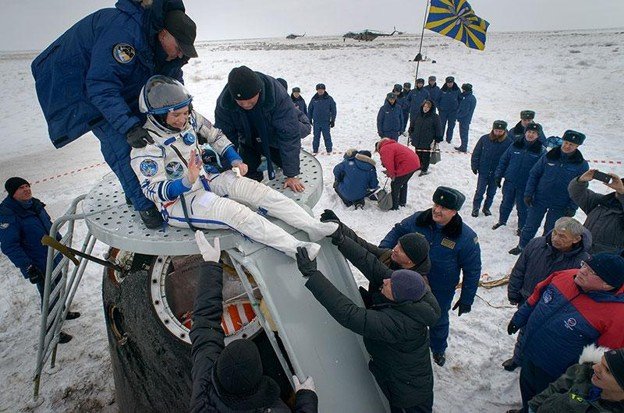
After months in microgravity, returning to Earth means more than coming home. It means asking the human body to readjust to the gravitational demands it has spent months adapting away from.
Standing up is one of the most ordinary things the human body does. It requires no conscious calculation of blood pressure, no deliberate integration of sensory signals, and usually no thought about how the muscles coordinate to maintain balance. Yet, after spaceflight, this seemingly simple action can become unexpectedly difficult.
During long duration space missions, astronauts live in an environment where the usual effects of gravity are greatly reduced. Their bodies adapt to this change, altering the way cardiovascular regulation, balance, and movement operate. When they return to Earth, these adaptations can become a challenge: the body must function again under gravitational conditions that it has not experienced for months.
This is not simply a matter of feeling weak after a long journey. It is a complex physiological transition involving multiple systems that must work together to maintain posture, regulate circulation, and coordinate movement.
NASA identifies orthostatic intolerance as a recognised risk following exposure to microgravity. Research also shows that astronauts can experience measurable difficulties with balance and locomotor tasks immediately after landing. Understanding these changes is important not only for post-flight recovery but also for preparing astronauts to operate safely during future missions to the Moon and Mars.
The cardiovascular challenge; When standing becomes difficult:
On Earth, gravity influences the distribution of blood throughout the body. When a person moves from lying down to standing, blood tends to accumulate in the lower body. The cardiovascular system responds through mechanisms involving the autonomic nervous system, changes in heart rate, and constriction of blood vessels to maintain arterial blood pressure and adequate blood flow to the brain.
In microgravity, this gravitational effect is substantially reduced. Body fluids shift towards the upper body, and the cardiovascular system adapts to the altered environment. Over time, changes in circulating blood volume and cardiovascular regulation can affect the body’s ability to respond when gravity is reintroduced.
NASA’s overview of cardiovascular research on the International Space Station explains how fluid redistribution and cardiovascular adaptation during spaceflight can contribute to difficulties regulating blood pressure after landing.
One concern is orthostatic intolerance (OI), which occurs when the body has difficulty maintaining adequate blood pressure and cerebral perfusion during upright posture. An affected astronaut may experience dizziness, light-headedness, weakness, or, in severe cases, fainting.
The mechanisms are multifactorial. Reduced plasma volume can contribute, as can changes in the autonomic regulation of blood vessels and heart rate. The importance of each mechanism varies between individuals, and not every astronaut develops clinically significant orthostatic intolerance.
The practical consequence is that returning to an upright position can place demands on a cardiovascular system that has adapted to a very different environment.
This also highlights an important distinction: cardiovascular intolerance is not the same as impaired balance. An astronaut may feel dizzy because of a cardiovascular response, experience disorientation because of sensorimotor readaptation, or encounter both difficulties simultaneously.
Why this matters: Standing, walking, and other upright activities may require careful monitoring during early recovery. Assessment of symptoms, blood pressure, heart rate, and tolerance of position changes can help medical teams identify cardiovascular limitations and guide safe activity progression.
The balance challenge: When the brain must readjust
Maintaining balance requires the nervous system to integrate information from several sensory systems.
The vestibular system, located in the inner ear, detects head movement and provides information that helps the brain interpret orientation and motion. Vision supplies information about the surrounding environment, while somatosensory feedback including proprioception helps the brain estimate body position and movement.
On Earth, these signals operate within a familiar gravitational environment. In microgravity, however, the relationship between sensory information and physical orientation changes. Astronauts adapt to moving and working without the usual gravitational reference, and the nervous system adjusts accordingly.
Upon returning to Earth, the sensory information available to the brain changes again. The nervous system must readjust to gravity-dependent cues while controlling posture and movement. This process has measurable functional consequences.
In a 2022 study published in Frontiers in Physiology, Clément and colleagues assessed 19 astronauts before and after long duration International Space Station missions. Their tests included sit-to-stand, recovery from a fall, tandem walking, and walking with turning. The researchers found that performance was impaired shortly after landing, with some deficits persisting for up to approximately one week.
The study, “Mission critical tasks for assessing risks from vestibular and sensorimotor adaptation during space exploration”, is particularly relevant because it evaluates functional tasks rather than relying exclusively on laboratory measurements of sensory function.
The findings show that readaptation can affect the execution of movements that people normally perform automatically. Standing steadily, walking along a line, turning around an obstacle, or recovering from a loss of balance may temporarily become more demanding.
These results do not mean that every astronaut will experience the same degree of impairment or follow an identical recovery timeline. They demonstrate that functional difficulties can persist beyond the moment of landing and deserve direct assessment.
Why this matters: Post-flight evaluation should consider dynamic balance, walking, turning, postural transitions, and recovery from instability, not simply whether an astronaut can stand still.
From physiological adaptation to functional impairment
Cardiovascular regulation and sensorimotor control are distinct processes, but their effects can converge during everyday activities.
Consider walking after landing. The cardiovascular system must maintain adequate circulation during upright movement. The vestibular system, vision, and proprioception must provide information for orientation and balance. Muscles must generate and control movement, while the brain coordinates the sequence of actions. If one or more of these systems is temporarily impaired, the task may become more difficult.
This is why research into post-flight recovery increasingly examines functional performance alongside individual physiological measures.
A further study by Clément and colleagues, published in Frontiers in Physiology in 2025, examined 10 private astronauts after missions lasting four to 21 days and compared their performance with that of 36 astronauts returning from missions lasting six to 12 months. The assessments included sit-to-stand, tandem walking, and walking with turning.
The researchers reported that astronauts returning from short duration missions also experienced difficulties with standing, walking, and turning shortly after landing. However, the functional effects were generally less pronounced than those observed after long duration missions.
The study, “Effects of short duration spaceflight on the execution of critical mission tasks”, provides evidence that sensorimotor readaptation is not exclusively a concern for astronauts returning from missions lasting many months.
However, the comparison should be interpreted in context. The groups differed in mission duration and other characteristics, and the findings do not establish a universal relationship between flight duration and the severity of every post-flight symptom.
The broader lesson is that completing a mission and regaining normal functional performance are different milestones. An astronaut may have returned safely but still require time and support before performing demanding physical tasks at their usual level.
Recovery does not happen at the same rate for everyone
Post-flight recovery is not a single event in which all physiological systems return to normal simultaneously.
Cardiovascular regulation, balance, movement coordination, strength, and endurance may follow different recovery trajectories. The extent and duration of impairment can vary according to individual characteristics, mission exposure, and the physiological system being assessed.
The 2022 study by Clément and colleagues provides a useful example. Astronauts were assessed shortly after landing, one day later, and again approximately six to 11 days after landing. Some measures improved relatively quickly, while deficits in certain functional tasks remained detectable during the later assessment.
These findings support the use of repeated measurements rather than relying on a single post-flight examination.
NASA’s overview of astronaut health care describes the medical monitoring and reconditioning that support astronauts after returning to Earth. Recovery programmes can address mobility, strength, aerobic conditioning, flexibility, balance, and other aspects of physical function according to individual needs.
The objective is not simply to wait for gravity readaptation to occur. It is to monitor the astronaut’s condition, identify relevant impairments, and support a safe return to physical activity.
An important distinction must be maintained here: findings from a particular study describe the participants and outcomes examined. They should not be converted into a universal recovery deadline for every astronaut or every physiological system.
What can rehabilitation contribute?
Rehabilitation offers a useful framework for understanding recovery because it connects physiological impairments with activities and functional outcomes.
In clinical practice, rehabilitation involves assessment, intervention, progression, and reassessment. A similar framework can inform post-flight reconditioning, although astronaut care must be adapted to the specific demands and risks of spaceflight.
Several areas are particularly relevant.
Cardiovascular tolerance and upright activity. Medical teams can assess symptoms, blood pressure, heart rate, and tolerance of position changes where appropriate. These findings can help guide the progression towards standing and walking safely.
Balance and movement coordination. Tasks such as tandem walking, turning, and changing position can reveal difficulties that may not be apparent during quiet standing. Assessment can help identify functional limitations and guide appropriate rehabilitation strategies.
Strength, endurance, and mobility. Astronauts undertake exercise countermeasures during spaceflight, but exercise does not guarantee that every aspect of post-flight function will be preserved. Individual assessment remains important for identifying deficits and planning reconditioning.
Functional performance. Sit-to-stand, walking, turning, and other task-based assessments can help establish whether an astronaut is regaining the abilities required for everyday activity and mission-related demands.
NASA’s (ASCR) Astronaut Strength, Conditioning and Rehabilitation programme describes the role of exercise and rehabilitation in supporting astronauts before, during, and after spaceflight.
For physiotherapy, the important principle is that recovery should not be judged by isolated measurements alone. A change in strength or cardiovascular function matters, but so does whether the individual can translate that capacity into safe, coordinated movement.
This does not mean that conventional terrestrial rehabilitation protocols can simply be transferred to astronauts. Post-flight interventions must be informed by spaceflight specific evidence, medical assessment, and the operational requirements of the mission.
Why this matters for the Moon and Mars
The implications of gravitational readaptation extend beyond returning to Earth.
Future exploration missions may require astronauts to move from prolonged microgravity exposure to environments with partial gravity, including the lunar surface and Mars. These transitions create different physiological and operational demands from returning directly to Earth.
The Moon’s surface gravity is approximately one-sixth of Earth’s, while Mars has approximately 38% of Earth’s surface gravity. Neither environment reproduces terrestrial gravity, so findings from post-flight recovery on Earth cannot automatically be applied to lunar or Martian landings.
Nevertheless, the functional difficulties observed after spaceflight raise an important question: what happens when astronauts must perform physically demanding tasks soon after arriving on another world?
They may need to leave a spacecraft, move across unfamiliar terrain, handle equipment, establish a habitat, or respond to an emergency. Difficulties with balance, orientation, or cardiovascular tolerance could complicate these activities.
The 2022 study by Clément and colleagues specifically examined tasks relevant to future exploration and suggested that additional sensorimotor countermeasures may be needed to preserve functional performance after prolonged weightlessness.
This remains an area for further investigation. The evidence does not establish exactly how astronauts will perform immediately after a long transit followed by landing on the Moon or Mars, nor does it identify a single intervention that will eliminate the risk.
Future research will need to determine how pre-flight preparation, in-flight countermeasures, post-landing assessment, and rehabilitation can best support astronauts during these transitions.
The challenge is therefore not only to keep astronauts healthy in microgravity, but also to prepare them to function when their gravitational environment changes.
Conclusion: Returning to gravity is another phase of adaptation
Gravity is so familiar on Earth that its contribution to ordinary movement is easy to overlook. Standing, walking, and maintaining balance depend on the coordinated activity of cardiovascular, sensory, nervous, and musculoskeletal systems.
Spaceflight changes the demands placed on these systems. When astronauts return, they must readjust to an environment in which gravity again influences blood distribution, sensory orientation, posture, and movement.
Research demonstrates that this transition can temporarily impair functional performance, including standing, walking, turning, and balance. The severity and duration of these changes vary, making individual assessment and appropriate reconditioning important parts of post-flight care.
For rehabilitation professionals, this presents a valuable perspective: physiological adaptation should also be understood through its consequences for functional independence and the ability to perform meaningful tasks.
For space medicine, the challenge extends further. As human missions venture towards the Moon and Mars, understanding how people adapt to changing gravitational environments will become increasingly important for protecting crew health and supporting safe operations.
Returning to Earth is not simply the end of a spaceflight. It is the beginning of another phase of human adaptation.
Image Credit: NASA astronaut Serena Auñón-Chancellor is helped out of the Soyuz MS-09 spacecraft just minutes after she landed in a remote area of Kazakhstan on Thursday, Dec. 20, 2018. (NASA/Bill Ingalls)
Article written by: Esha Ejaz
References:
- NASA identifies orthostatic intolerance as a recognised risk: https://www.nasa.gov/reference/fundamentals-of-human-health/
- NASA’s overview of cardiovascular research: https://www.nasa.gov/general/station-science-101-cardiovascular-research-on-station/
- In a 2022 study: https://doi.org/10.3389/fphys.2022.1029161
- The study, Effects of short duration spaceflight on the execution of critical mission tasks: https://www.frontiersin.org/journals/physiology/articles/10.3389/fphys.2025.1677377/full
- NASA’s overview of astronaut health care: https://www.nasa.gov/missions/station/faq-the-real-story-about-astronaut-health-care-in-space/
NASA’s ASCR programme: https://www.nasa.gov/directorates/esdmd/hhp/astronaut-strength-conditioning-and-rehabilitation/