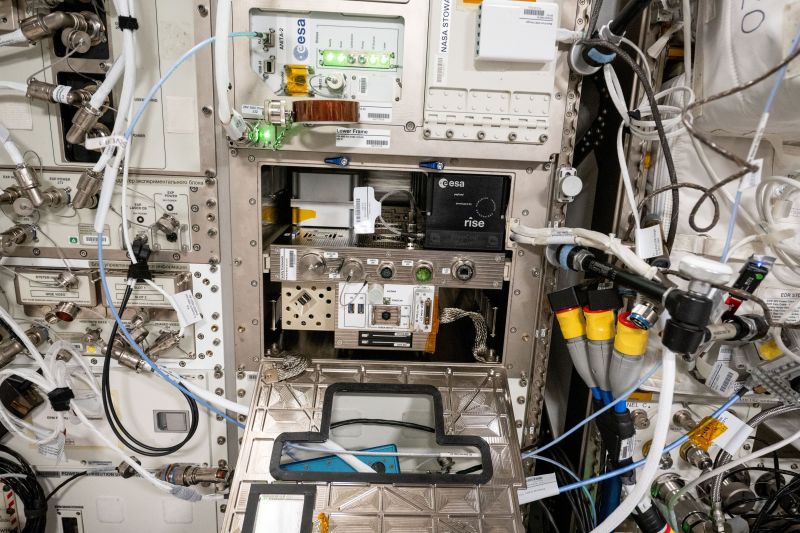
The DropCoal (Droplet Coalescence) experiment, a collaborative effort led by Romanian InSpace Engineering (RISE) and supported by the European Space Agency – ESA, was just installed in the ICE Cubes Service Facility on the Columbus module of the International Space Station (ISS). The objective of the mission is to understand how droplets form and interact in microgravity. The applications of the findings could provide progress from the fields of meteorology to space medicine and propulsion technology.
The project’s core mission is to observe and document droplet formation and coalescence under microgravity conditions, using sophisticated mechanisms that allow precise control and ultra-fast video recording. Successfully designing and manufacturing the complex experimental apparatus, the technical expertise of RISE transformed an innovative scientific concept into a fully functional space experiment, meeting rigorous mission requirements.
The implications of the DropCoal experiment could be far-reaching:
– Enhanced understanding of cloud and raindrop formation processes
– Improved methods for administering medicine in space environments
– Advanced insights into spacecraft fuel management and combustion dynamics
– Development of more sophisticated fluid interaction models
On November 15th, the experiment was powered on the ISS, marking a significant milestone. The RISE team successfully initiated operations from their Mission Control Room at their headquarters, with initial system checks confirming the functionality of critical components like telemetry reporting and droplet pumping mechanisms. As the experiment progresses through its commissioning phase, scientists anticipate generating comprehensive datasets that will be shared with the scientific community, ultimately enhancing our understanding of fluid dynamics in microgravity. This research holds the potential to unlock innovative solutions that could benefit industries and scientific disciplines both in space and on Earth.
𝗣𝗶𝗼𝗻𝗲𝗲𝗿𝗶𝗻𝗴 𝗙𝗹𝘂𝗶𝗱 𝗗𝘆𝗻𝗮𝗺𝗶𝗰𝘀 𝗶𝗻 𝗦𝗽𝗮𝗰𝗲: 𝗧𝗵𝗲 𝗗𝗿𝗼𝗽𝗖𝗼𝗮𝗹 𝗘𝘅𝗽𝗲𝗿𝗶𝗺𝗲𝗻𝘁 𝗼𝗻 𝘁𝗵𝗲 𝗜𝗦𝗦