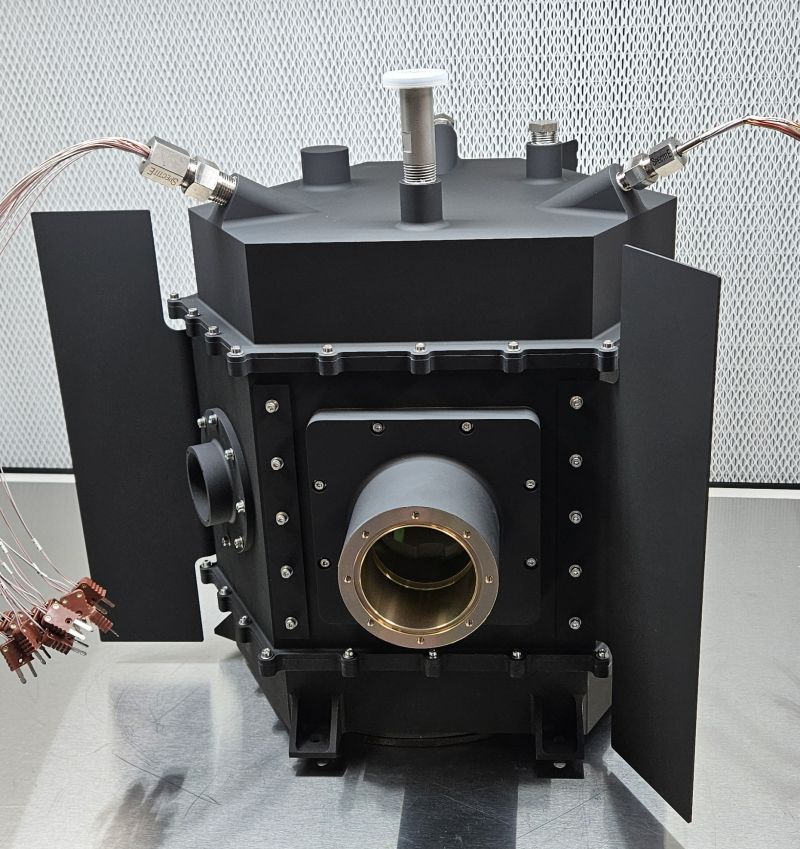
The European Space Agency – ESA upcoming Mars mission will feature a new nuclear-powered space power source that uses the radioactive decay of americium. This is a significant step towards ESA’s goal of reducing its dependence on other space agencies for power systems in future missions to other planets.
Europe’s first Mars rover, Rosalind Franklin, has faced numerous delays due to issues like the COVID-19 pandemic, and the cancellation of ESA’s partnership with the Russian space agency Roscosmos following Russia’s invasion of Ukraine. To proceed without Roscosmos, ESA has developed new capabilities and partnered with NASA to fill the remaining gaps in the mission plan.
The EuropeaN Devices Using Radioisotope Energy (ENDURE) project led by the University of Leicester, aims to provide ESA with its own Radioisotope Power System (RPS) capability. This will enable the agency to power future missions to other planets without relying on external partners. Another deliverable of ENDURE is a device that harnesses the heat produced by the decay of radioactive elements. While a Radioisotope Heater Units (RHU) uses the heat naturally produced by radioactive decay, a nuclear battery — known as a radioisotope thermoelectric generator — converts that heat into electrical power.
RHUs have been used in previous missions, but ESA’s RHU is the first to use americium-241, a by-product of plutonium decay. Although americium-241 has a lower power output per gram compared to plutonium-238, it is more abundant and cost-effective, potentially making the americium RHUs less expensive overall.
The collaboration with NASA Glenn Research Center will look at ways to generate electrical power from the University’s heat sources at higher efficiencies using Stirling convertor technology in what are called Radioisotope Stirling Generators (RSG). These generate electricity by heating and cooling a ‘working gas’ inside a sealed system causing a piston to move back and forth, which in turn produces electrical power. A unique feature of the University of Leicester heat source design is that it can be coupled to three Stirling convertors, and so could be more reliable for future space missions.
The current work is being funded by the UK Space Agency International Bilateral Fund, and NASA’s Radioisotope Power Systems Program. The results of this work will help generate electricity in some of the most challenging environments such as the 14-day lunar night. As the power source contain radioactive materials, the team at the University of Leicester, is working diligently to fulfill the launch-safety requirements in time for the planned 2028 launch.
University of Leicester partners with NASA for New Nuclear Power Source for First European Mars Rover