


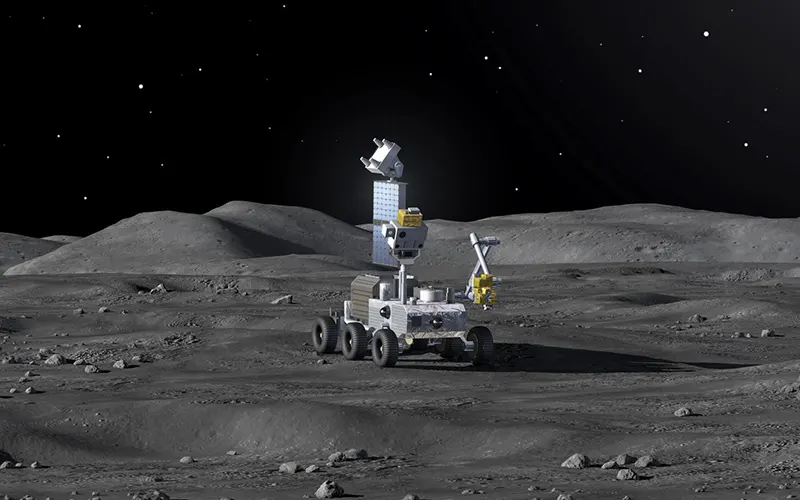
We know water ice exists at the Moon’s south pole. What we don’t yet know is how much is there, how deep it lies, and whether it can realistically be extracted. Those are not small questions — the answers could determine whether the Moon becomes a genuine staging post for deep space exploration, providing drinking water, oxygen, and rocket fuel, or remains a destination that depends on resupply from Earth. ESA’s MAGPIE, the Mission for Advanced Geophysics and Polar Ice Exploration, is designed to help find out.
MAGPIE is being developed under ESA’s Small Missions for Exploration initiative, with €2.7M ($3.2M) in funding secured to date. The MAGPIE rover itself is built on ispace-Europe’s heritage lunar rover design, extended with a strong consortium of European partners and a clear objective: directly characterise water ice deposits at the Moon’s south pole, where permanently shadowed craters may have preserved frozen volatiles for billions of years.
At the heart of the rover is the Lunar Volatiles Scout (LVS), developed by the Technical University of Munich with support from OHB SE. The LVS will drill into the lunar regolith, heat the extracted material, and analyse the released gases for water and other volatiles.
MAGPIE’s instrument suite extends beyond the drill:
- HardPix, a neutron spectrometer from Czech Technical University in Prague, will detect subsurface hydrogen signatures
- RIMFAX (Radar Imager for Mars’ Subsurface eXperiment), a subsurface radar system originally flown on NASA’s Perseverance rover, is being adapted by the University of Oslo for lunar use. It will map underground layers to identify ice-rich deposits
- A KP Labs data processing unit will manage onboard data, with results transmitted to Earth for analysis by The Open University
Together, these instruments represent one of the most comprehensive European attempts yet to characterise lunar water resources in situ.
Europe’s Broader Lunar Ambition
MAGPIE is targeting a 2028 launch. The south pole is already drawing serious attention — India’s Chandrayaan-3 became the first mission to soft-land in the region in 2023, confirming sulfur deposits and generating thermal data that suggests ice may be more accessible than previously assumed.
Alongside ESA’s Lunar Prospecting and Scouting Rover (LPSR), developed under the Prospect programme, MAGPIE signals a deliberate European commitment to in-situ resource utilisation — the ability to live off the land in space. Whether it can resolve the outstanding questions about quantity and accessibility may quietly shape how Europe positions itself in the next chapter of lunar exploration.
Image Credit: ESA / P. Carril
References
ispace-EUROPE Completes Mission Definition Review for ESA-backed MAGPIE mission, Advancing Europe’s First Lunar Polar Resource Prospecting Rover
Technical University of Munich – Lunar Volatiles Scout (LVS)
https://www.asg.ed.tum.de/en/lpe/research/lvs-on-magpie/
Silicon Luxembourg – MAGPIE Mission Overview (2025)
https://www.siliconluxembourg.lu/magpie-mission-ispace-europe-to-explore-moon-south-pole/
PayloadSpace – ispace Inches Closer to Another Lunar Attempt (2025)
https://payloadspace.com/ispace-inches-closer-to-another-lunar-attempt/
Miniature semiconductor neutron spectrometer HardPix for surface mapping of lunar water
https://doi.org/10.1016/j.actaastro.2022.09.018
Ice Confirmed at the Moon’s Poles
https://www.jpl.nasa.gov/news/ice-confirmed-at-the-moons-poles