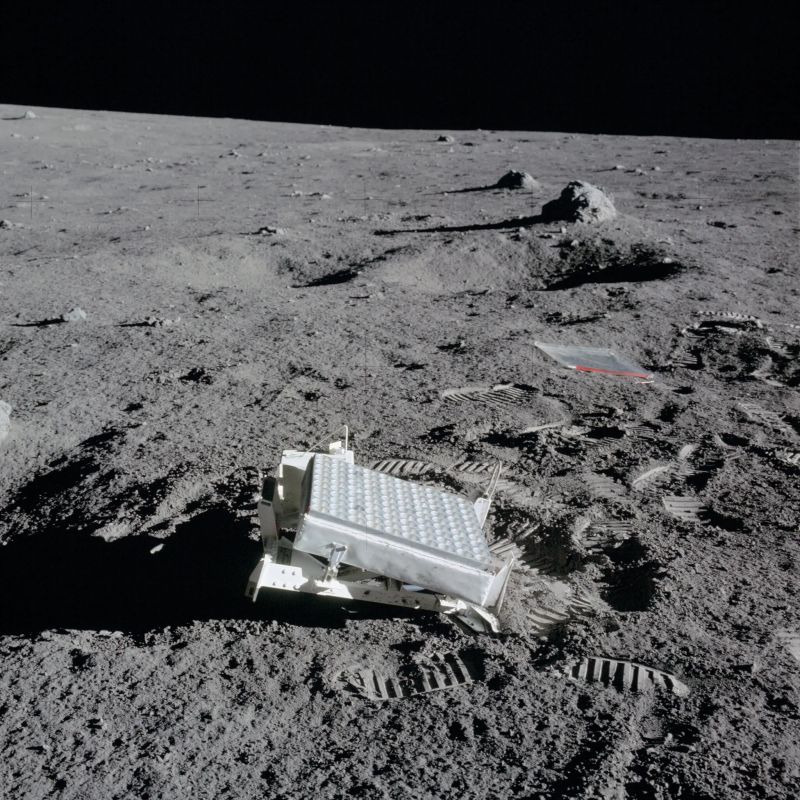
Lunar retroreflectors have transformed from simple distance-measuring tools to navigation instruments over five decades of space exploration. The upcoming deployment of new Laser Retroreflective Arrays (LRAs) aboard Firefly Aerospace‘s Blue Ghost Lander Mission 1 marks another milestone in this evolution, joining nine other payloads in NASA – National Aeronautics and Space Administration‘s Commercial Lunar Payload Services (CLPS) initiative.
The journey began with Apollo 11’s lunar laser retroreflector in 1969, which have been instrumental in precisely measuring the Earth-moon distance for over half a century with the discovery that the Moon is moving slightly away from Earth.
Modern LRAs represent a significant advancement in this technology. These compact devices, measuring just over 5cm (2 inches) in diameter and weighing less than 30 gr (an ounce), showcase remarkable engineering efficiency. Their design incorporates eight quartz-corner-cube prisms within an aluminum frame, creating an omnidirectional reflection capability that maintains functionality regardless of incident angle.
The technology demonstrated its potential in December 2023 when NASA’s Lunar Reconnaissance Orbiter successfully established laser communication with an LRA on ISRO – Indian Space Research Organization‘s Vikram lander. This achievement marked the first laser reflection between an orbiting spacecraft and a lunar surface device, opening new possibilities for precise positioning and navigation.
LRAs stand out for their elegant simplicity and durability. These passive instruments require no power source yet provide crucial positioning data that supports various applications, from space navigation to scientific research. Their robust construction ensures decades of functionality in the harsh lunar environment, making them valuable assets for long-term lunar exploration.
These devices contribute to establishing a network of reference points on planetary surfaces. Similar units deployed on Mars, including one on the Perseverance rover, demonstrate the versatility of this technology across different planetary environments.
The integration of LRAs into future missions promises to enhance our capabilities in space navigation and scientific research, supporting humanity’s expanding presence in space while building upon the foundation laid by Apollo-era innovations.
The Evolution of Lunar Retroreflectors: From Measuring Distance to Location Determination