


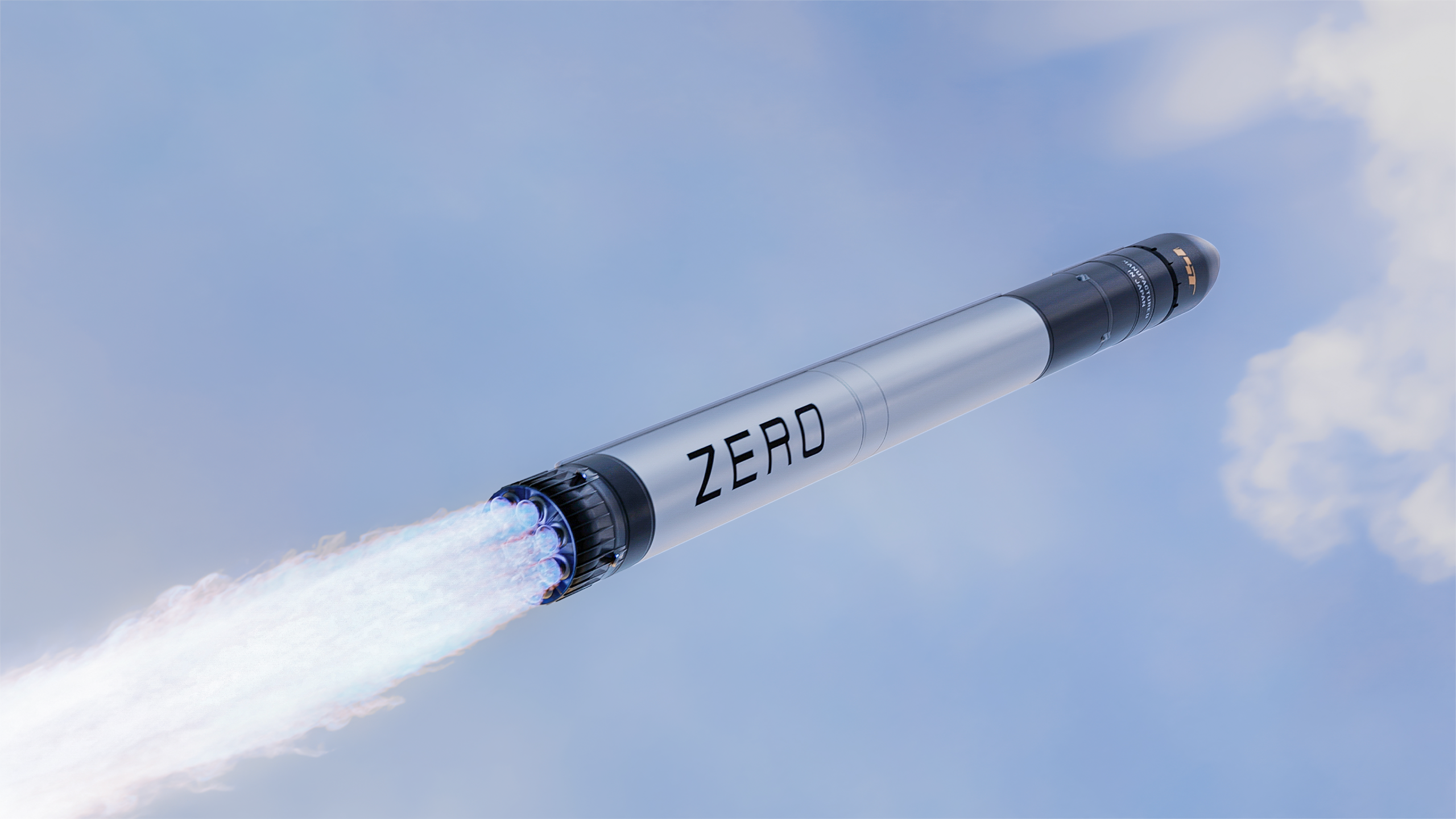
Demand for low-cost small satellite launch continues to grow — particularly from Asia. Japan-based launch vehicle startup Interstellar Technologies is addressing this with renewable propulsion and a vertically integrated commercial model.
Founded by Takafumi Horie and led by CEO Takahiro Inagawa, the company pursued a disciplined, iterative development path. That approach paid off in May 2019, when their MOMO sounding rocket became the first privately developed Japanese vehicle to reach space — crossing the Kármán line, as its name (a play on the Japanese character for “one hundred”) was always intended to mark.
Building on that validated flight heritage, the team is now developing their orbital launch vehicle, ZERO.
The vehicle: ZERO is a two-stage launcher designed to deliver 880 kg to Low Earth Orbit. Its first stage uses a cluster of nine engines; the second stage uses a single engine of the same design with a vacuum-optimised nozzle. The deliberate reuse of a common engine across both stages enables higher-volume manufacturing of shared components — a direct strategy for reducing unit costs compared to bespoke, low-volume production.
The propellant: ZERO’s engine runs on locally sourced liquid biomethane — making it the first privately developed rocket engine of its kind in the world, and the only commercial launch vehicle to use a renewable propellant. While other next-generation rockets such as Starship, New Glenn, and Zhuque-2 use conventional fossil-derived methane, ZERO’s biomethane is sourced from livestock manure in Hokkaido, adding a genuinely distinctive sustainability dimension to its commercial proposition.
The funding: In early 2026, Interstellar Technologies closed a $130M Series F round led by Woven by Toyota. The stated intent: apply automotive-industry expertise in automation and cost-efficient manufacturing to aerospace production to increase launch cadence. Combined with a $47M Japanese government SBIR grant, cumulative backing now stands at nearly $300M.
The pipeline: Eight international customers are already secured for ZERO’s planned 2027 inaugural flight.
The logic here is coherent: common parts, high-volume manufacturing, renewable propellant, and automotive-industry expertise in automation and cost-efficient manufacturing — all converging on the same goal of driving down launch costs. Whether the 2027 timeline holds will be the real test, but the foundation is more substantive than most at this stage.
References:
Interstellar Technologies Secures 47.24 Million USD From Japan SBIR Program
Companies detailed news and gallery
https://en.wikipedia.org/wiki/Interstellar_Technologies
Interstellar Technologies
Japanese launch company Interstellar Technologies raises $130 million
Interstellar Technologies: A Japanese Small Satellite Launch Provider
Why Toyota And Honda Are Investing In Space Technologies
Toyota backs Japanese space startup Interstellar to mass-produce rockets
(space one- competitor)
CASE STUDY Interstellar Technologies tests the PNT Capabilities of its ZERO Satellite Launch vehicle
Everything about Zero
ZERO by Interstellar Technologies Inc.: Lowering the Cost of Access to Space from Japan
https://digitalcommons.usu.edu/cgi/viewcontent.cgi?article=6054&context=smallsat
Interstellar Technologies’ Satellite Business Passes Stage Gate for JAXA’s Space Strategy Fund’s Program
https://www.istellartech.com/7hbym/wp-content/themes/ist_2023/assets/pdf/usersguide_zero.pdf
Interstellar Technologies ZERO Payload User’s Guide (PDF)
ZERO_User’s Guide_Ver 2.ZERO_User’s Guide_Ver 2
Using cow dung to fuel space rockets
Interstellar Technologies Completes Series F Round With 20.1 Billion JPY ( 129.7 Million USD)