


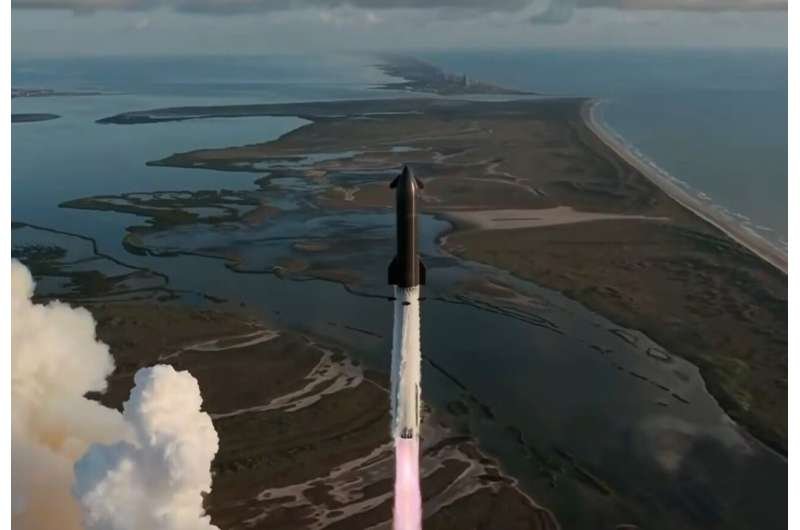
On 28 September 2026, Starship, the biggest and most powerful launch vehicle ever built, reached orbit for the first time on its 14th test flight. Every previous flight had been suborbital.
The 124-meter super-heavy launcher lifted off from SpaceX’s Starbase in Texas and completed nearly two orbits. Along the way, it deployed 26 Starlink V3 satellites (2 tons each), one after another, at an altitude of 270 kilometres.
It was not flawless. One of the 33 Raptor engines on the Super Heavy booster shut down early, and one of the six engines on the upper stage, known as Ship, did the same. The team debated whether to continue with the orbital insertion burn, decided to go ahead, and the 19-second burn went smoothly. The booster splashed down in the Gulf of Mexico. Out of caution, SpaceX shortened the planned mission and sent the Ship to a Pacific splashdown north of Hawaii just over three hours after launch.
SpaceX will move its Starlink launches from Falcon 9 to Starship to take advantage of the much larger lift capacity. Starship can lift 100 to 250 tonnes, while Falcon 9 can launch 17.5 tonnes into low Earth orbit (LEO) with booster recovery (22.8 tonnes when expendable).
These were big successes, but Starship is not yet fully mature. A few hurdles remain.
Fixing the engine shutdowns
Both a Super Heavy booster engine and an upper stage engine shut down early. The cause needs to be investigated and resolved.
Catching the hardware
SpaceX has caught the booster with the tower’s chopstick arms on three flights, but has not yet tried it with the 52-meter Ship. For the next flight, SpaceX is reportedly considering a Ship catch, possibly even a double catch with the booster.
Launch cadence
Starship has flown from only two pads at Starbase. Three pads are being built in Florida, and the $100 billion, 12-pad Starship Louisiana complex is planned to break ground in 2027.
NASA is counting on Starship too. Next year, it expects to test a Starship lander in Earth orbit during Artemis 3, ahead of a crewed Moon landing that could take place in early 2028.
Why this matters for New Space
Falcon rideshares end in late 2028, and many startup business cases depend on cheaper launch. Losing that option, is causing short-term issues. There is no super-heavy launcher competition in sight for Starship.
Beyond launching its own satellites, SpaceX plans to use Starship for trips to the Moon and Mars, while other commercial space ventures are counting on it to lower the cost of access to space.
Image Credit: SpaceX
Starship just reached orbit for the 1st time. What’s next for the SpaceX megarocket?
SpaceX’s Starship rocket does its job during first orbital flight
https://phys.org/news/2026-09-spacex-starship-rocket-job-orbital.html
SpaceX catches giant Starship booster with ‘Chopsticks’ on historic Flight 5 rocket launch and landing
https://www.space.com/spacex-starship-flight-5-launch-super-heavy-booster-catch-success-video