


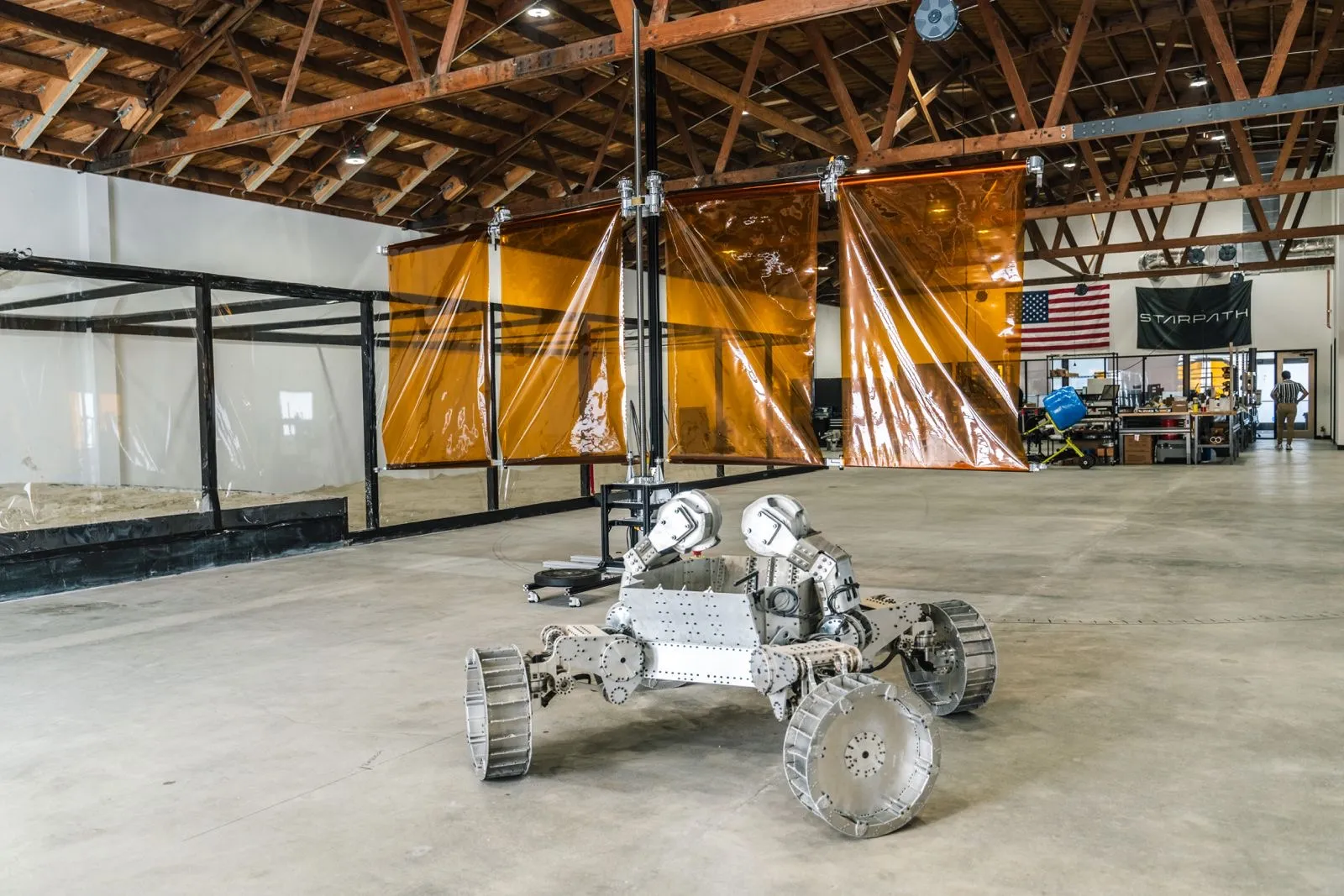
Emerging from stealth mode, Starpath Robotics has revealed its ambitious plans to mine and refine water on the Moon and Mars to create rocket propellant. The start-up creates the hardware to acquire and process extraterrestrial materials into propellant.
Starpath’s initial plan involves deploying a fleet of approximately 50 mining machines on the lunar surface to extract water-rich regolith from inhospitable regions like the permanently shadowed craters at the lunar South Pole. The collected material will be transported to processing plants or refineries, where it will be purified into water and then separated into its constituent elements.
The most water-rich sites on the moon are those that are the most inhospitable: places like the lunar South Pole, where icy craters are in permanent darkness and temperatures can plunge as low as -203°C (-334 degrees Fahrenheit). Developing rovers and other vehicles that can survive this environment has been a formidable challenge — but Starpath is working on this problem. The mining machines will shuttle between the craters and the refineries, dumping the material and recharging using solar arrays.
The extracted liquid oxygen will be stored in underground Teflon bags until it can be processed into rocket propellant. While companies like SpaceX will still need to provide the other propellant component, such as methane, the cost improvements from locally sourced liquid oxygen are expected to be significant.
Starpath has secured $2.5 million in pre-seed funding from investors Hummingbird Ventures and Valhalla Ventures. The company is targeting three main customer types:
-Companies that want to provide in-orbit refueling like @OrtbitFab
-Rendezvous-landers, like @Blue Origin’s Blue Moon or @Ispace lunar lander, which will be capable of landing and taking off from the moon and docking with a spacecraft in-orbit.
-Starship-class vehicles, namely @SpaceX Starship.
It is worth noting that Starpath has recently won the 2nd prize ($500,000) at the Break the Ice lunar challenge where participants from around the world competed with a common goal of inventing robots that can excavate and transport the icy regolith on the Moon. The Starpath team developed a robotic mining tool that features a drum barrel scraping mechanism for breaking into the tough lunar surface. This allows the robot to mine material quickly and robustly without sacrificing energy. In addition to the prize the team will be given the chance to use Marshall Space Flight Center’s thermal vacuum (TVAC) chambers to continue testing and developing their robots. These chambers use thermal vacuum technologies to create a simulated lunar environment, allowing scientists to build, test, and approve hardware for flight-ready use.
Founded in mid-2022 Starpath aims to demonstrate the functionality of its full system in a terrestrial environment within the next 24 months before space-qualifying all subsystems. The company hopes to have its mining and refinery system ready for launch to the lunar South Pole on a Starship by 2026.