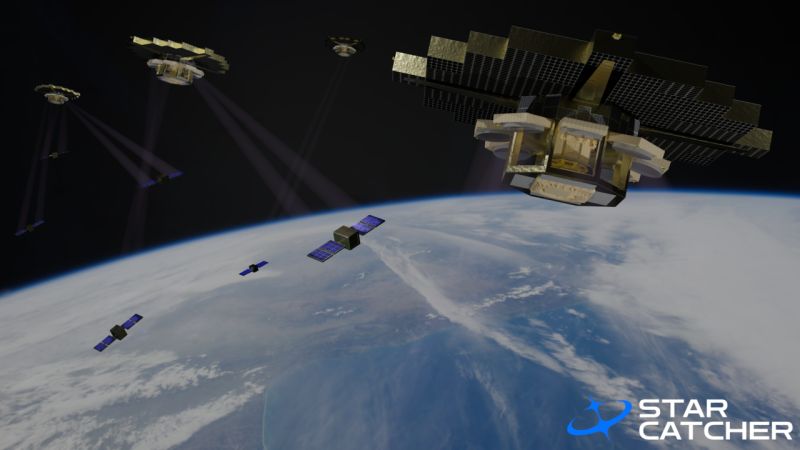
Star Catcher, a space-based power technology startup, has secured $12.25 million in seed funding to develop the world’s first space-based energy grid. The network plans to deliver energy on demand and at higher concentrations of energy than the Sun to the existing solar arrays of client spacecraft in Low Earth Orbit (LEO), enabling them to generate up to five to ten times the amount of power they would generate otherwise without requiring any modifications to existing solar arrays.
With projections indicating LEO will host over 40,000 satellites by 2030, power demands are expected to surge to 840 megawatts. As satellite launch costs continue to fall, power needs are accelerating. Energy demand is outstripping the supply that current solar panels and batteries provide. Once deployed, satellite operators can shift to a shared infrastructure mindset, where power consumption will not be constrained by what satellites bring with them. Star Catcher’s solution promises to support increasingly power-hungry space operations, from On-Board Processing (OBP) and Direct-2-Device satellites to AI edge-computing and remote sensing payloads.
Founded by space industry veterans Andrew Rush (former CEO & President of Made in Space and COO of Redwire) and Michael Snyder (former co-founder and Chief Engineer of Made In Space and CTO of Redwire), alongside VC expert Bryan Lyandvert, Star Catcher has already garnered significant interest from potential clients. The company’s pay-as-you-go model aims to reduce upfront costs for satellite operators, making space-based operations more accessible and economically viable.
Currently Star Catcher is hiring resources to make their vision a reality and plans to conduct ground-based demonstrations by early 2025, followed by an in-space demo in December 2025. While initially focused on LEO applications, the company envisions expanding its technology to support lunar operations, like start-up Volta Space Technologies which also plans a lunar power satellite network.
Star Catcher Raises $12.25M to Build Space-Based Power Grid