


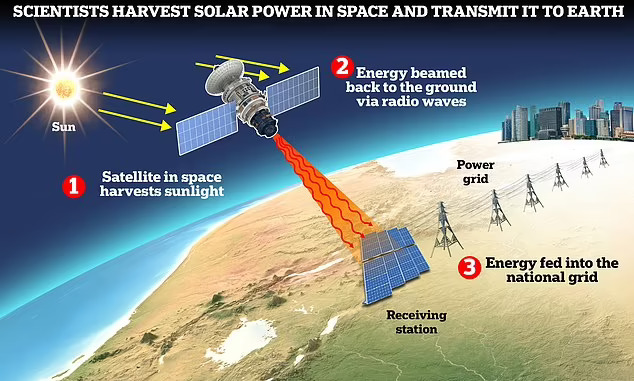
As we strive towards a Net Zero future by 2050, it’s becoming increasingly clear that our current renewable energy infrastructure may not be sufficient to meet our growing energy demands. Space Based Solar Power (SBSP) – a revolutionary concept that could provide clean, continuous, and reliable energy on a global scale provides a sustainable solution.
U.K.-based startup @Space Solar is leading the charge with their scalable Constant Aperture Solid State Integrated Orbital Phased Array (CASSIOPeiA) design. This innovative system, spanning 1.7 km in diameter and 4 km in length, is equipped with hundreds of thousands of integrated power modules that receive solar energy and beam it back to Earth using high-frequency radio waves.
In Geostationary orbit, roughly 36,000 km from Earth, satellites appear stationary relative to Earth which is ideal to continuously beam energy microwaves to a fixed point on Earth. Since the angle between the CASSIOPeiA satellite, sun and Earth is constantly changing. What sets CASSIOPeiA apart is its ability to provide firm power with pinpoint accuracy, thanks to its 360° beam steering technology recently showcased through Space Solar’s Horizontal Array for Receiving RadIo Energy Retrodirectively (HARRIER) demonstrator. By maintaining a constant view of both the Earth and the sun, one CASSIOPeiA satellite could potentially deliver up to 2GW of carbon-free power – enough to supply a city of 2 million people, 24/7, 365 days a year.
Space is traditionally expensive because one-off monoliths were built. New Space and CASSIOPeiA feature modular design and hundreds of thousands of identical modules, and this high-volume manufacture allows us to lower the unit production costs and build at scale. This provides the ability to build multiple at a time, commissioning tens of Gigawatts of generation capacity every year.
By providing affordable, abundant, clean and reliable energy, SBSP could complement our existing technologies and help optimize our energy systems as we work towards Net Zero. With the backing of the @UKSA and the potential for international partnerships, Space Solar could revolutionize the clean energy landscape.