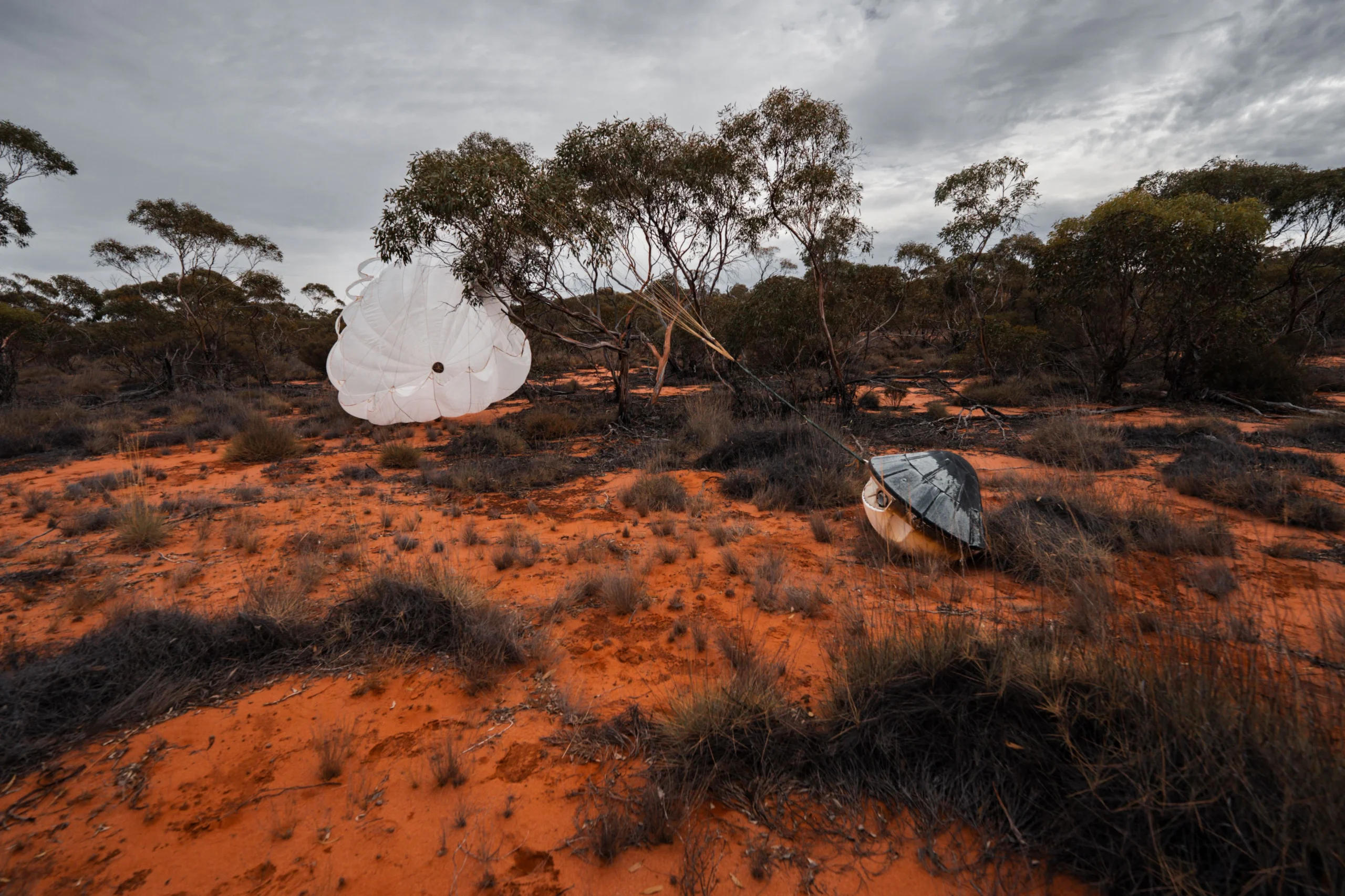
Varda Space Industries‘ W-2 capsule successfully touched down at the Koonibba Test Range in South Australia on February 28, 2025. The 120-kilogram capsule completed its six-week orbital mission, demonstrating significant advances in both reentry technology and in-space manufacturing capabilities.
Varda Space is a microgravity-enabled life sciences company that processes materials in orbit and returns them to Earth. The W-2 mission serves dual scientific and commercial purposes. Carrying the Air Force Research Laboratory’s (AFRL) Optical Sensing of Plasmas in the Reentry Environment (OSPREE) spectrometer, the capsule captured unprecedented in-situ measurements of plasma formation during hypersonic reentry—data previously impossible to gather through ground-based simulations. The mission delivered real-time measurements at speeds exceeding Mach 25, providing valuable insights for thermal protection systems and hypersonic vehicle development.
The spacecraft incorporated a heat shield developed with NASA Ames Research Center and utilized a Rocket Lab satellite bus. After launching aboard SpaceX’s Transporter-12 rideshare mission from Vandenberg Space Force Base on January 14, the capsule spent six weeks collecting data before its dramatic reentry, captured on video showing colourful plasma interactions as the vehicle decelerated through the atmosphere.
This landing marks the first commercial spacecraft touchdown on Australian soil, following Varda’s earlier W-1 mission that became the first commercial spacecraft to land in Utah on U.S. territory in February 2024.
An important payload was the Varda enhanced pharmaceutical reactor for the company’s in-orbit manufacturing plans. Varda aims to become a major player in the emerging in-space manufacturing industry, utilizing the unique environment of microgravity to manufacture products including pharmaceuticals. The capsule will undergo processing at Southern Launch’s facilities before returning to Varda’s Los Angeles headquarters for comprehensive analysis, with findings expected to advance thermal protection systems, sensor designs, and aerodynamics for future hypersonic vehicles.
Space Logistics: Varda’s Successful Australian Landing Demonstrates Orbital Manufacturing Potential