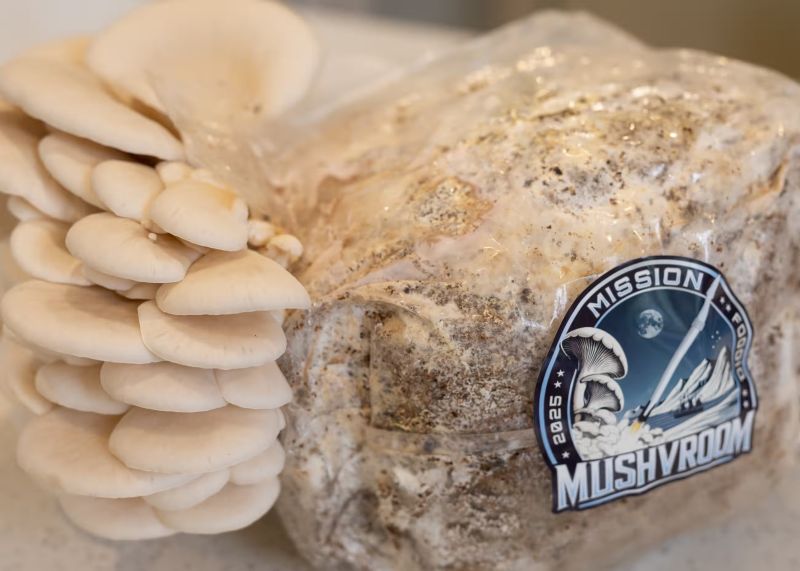
In a notable step forward for space agriculture, Australian firm FOODiQ Global cultivated and grew oyster mushrooms in microgravity aboard Fram2, the first human spaceflight mission to traverse Earth’s polar regions. On the final day of the three-and-a-half-day mission, which was launched on the 31st of March 2025, the experiment addressed fundamental questions about food production capabilities that could sustain future deep space exploration.
In her paper presented at the IAC 2024 [1], FOODiQ Global CEO Dr. Flávia Fayet-Moore examines how growing mushrooms as a space crop can contribute to exploration missions, with nutritional and culinary benefits in closed-loop systems. These fungi break down waste carbon containing waste products, effectively participating in biogenerative processes while reducing dependence on Earth resupply missions.
Here is some further insight:
🌱 The Practical Power of Fungi: Unlike traditional crops, which require soil, large amounts of water, and sunlight, mushrooms thrive in compact, controlled environments with minimal inputs. They can grow on organic waste, do not need to photosynthesize, and complete their growth cycle in days rather than weeks. This makes them a perfect candidate for microgravity environments like the International Space Station (ISS), where resource efficiency is crucial.
🌀 A Closed-Loop Solution: Mushrooms can play a role in closed-loop bioregenerative systems, ecosystems that recycle waste into usable inputs. On the ISS or future lunar/Martian bases, mushrooms could be cultivated using organic waste, and limited water, contributing to air purification, nutrient recycling, and ultimately food production. This dramatically reduces reliance on expensive and logistically complex resupply missions from Earth.
🍄 More Than Just Calories: The benefits of mushrooms extend far beyond practicality. They’re nutritional powerhouses, rich in fiber, essential vitamins (like B), can produce vitamin D upon exposure to UV-light, and is rich in several minerals, providing astronauts with vital nutrients required to maintain physical health during long missions.
👨🚀 Looking Ahead: As we prepare for crewed missions to the Moon, Mars, and beyond, mushrooms could play a key role in a sustainable life support system. Different fungal species could be cultivated for distinct purposes: some for construction materials, others for nutrition, and yet others for medicinal properties. This versatility could significantly reduce the payload required for extended missions, as a single biological system could serve multiple crucial functions. Overall, this small organism holds transformative potential not just for nutrition but for comprehensive ecological systems supporting human space exploration.
Space Farming: Oyster Mushrooms Grown in Polar Orbit