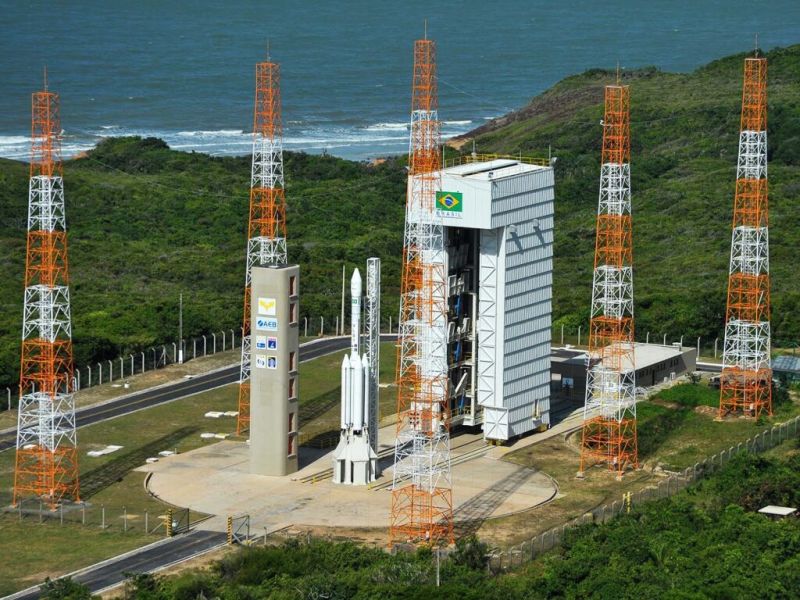
Nestled just 2 degrees south of the equator, Alcântara Space Centre in Brazil possesses one of the most geostrategically ideal launch sites in the world. Its location allows rockets to leverage Earth’s rotational velocity, reducing fuel requirements and increasing payload capacity—a crucial factor for commercial launch viability. Despite this advantage, the site remained underutilized for decades due to historical, political, economic, and regulatory barriers. However, the tide is turning.
INNOSPACE, the first South Korean private New Space company, became the first enterprise to launch from Alcântara in 2022, successfully deploying its HANBIT-TLV (Test Launch Vehicle). By March 2025, the company completed integrated system tests for the HANBIT-Nano rocket, designed to carry small satellites into orbit. The vehicle supports launches for both domestic and international clients, with HANBIT-Nano being able to deliver payloads of 90 kg to a 500 km-high sun-synchronous orbit (SSO). The first HANBIT-Nano is scheduled for this July.
The path to obtain launch permission presented significant challenges, as detailed in a recent paper [1]. In response, the Brazilian government took decisive action in late 2024, passing legislation to establish “Empresa de Projetos Aeroespaciais do Brasil S.A.,” known by the acronym Alada (“Winged” in Portuguese), authorized to negotiate launches with private companies.
In 2024, Innospace formalized multiple agreements with the Brazilian government and institutions to launch domestically produced satellites and inertial systems, demonstrating its long-term commitment.
The strategic partnership with Innospace contributes to repositioning Brazil within the global launch services market, an arena traditionally dominated by the U.S., Europe, and China. This momentum aligns with Brazil’s and the Brazilian Space Agency (AEB/MCTI) Agency’s broader vision of modernizing its space sector through stimulating its domestic ecosystem and international collaboration.
With INNOSPACE‘s success signing more international orders to be launched from Brazil, a strengthened regulatory framework, and heightened governmental support, Brazil’s space launch sector is on the right path to welcomes additional participants. With simplification of the regulatory process, Alcântara has the potential to compete with global spaceports not merely as a launch facility, but as a vibrant innovation hub for space technologies across Latin America. This could represent the beginning of Brazil’s long-anticipated advancement into the forefront of the global space community—a transformation that combines strategic geographic advantages with forward-thinking partnerships to establish a sustainable presence in the growing New Space economy.
South Korean Launch Company Innospace Signals Brazil’s Untapped Launch Potential