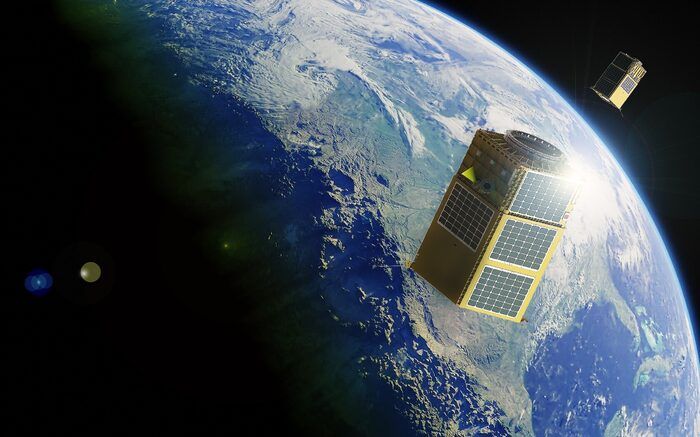
As a great example of applying Earth technology to Space,Sony is taking its expertise in CD player laser technology to new frontiers. Through its newly established Sony Space Communications (SSC), the tech giant is addressing one of the most pressing challenges in satellite communications: the growing scarcity of radio spectrum on our planet.
This innovative pivot demonstrates how groundbreaking consumer technology can find unexpected applications in solving complex space challenges. Sony’s adaptation of optical disc laser technology for satellite communications showcases the company’s ability to leverage its core competencies in novel ways.
The timing couldn’t be better. As the number of New Space satellites in LEO continues to surge, traditional radio frequency-based communications face increasing limitations. SSC proposes mass-produced, low-cost, laser-based communication systems that promise higher data transmission rates while requiring less power and smaller hardware footprints – crucial advantages for the growing micro and small satellite market.
The company has already demonstrated promising results. Their SOLISS (Small Optical Link for International Space Station) project successfully established two-way laser communications with a ground station in Japan, transmitting high-definition imagery from Kibo, the Japanese experimental module on the International Space Station. Building on this success, Sony has partnered with Astro Digital to launch two test satellites in 2026, marking a significant step toward commercialization. SSC plans to test high data-rate optical communications between the satellites and the ground, and also between each other in low Earth orbit (LEO).
What makes this development particularly interesting is the technology heritage. The same fundamental mass-produced technology that once brought music to millions through CD players is now being adapted to enable high-speed space communications.
Sony’s journey exemplifies a trend in the New Space industry with more established companies adapting their Earth-based technologies for space applications. The key advantage lies in technology heritage and mass production capabilities: space components can be manufactured at a fraction of the traditional cost, making space technology accessible to startups and innovators. This dramatic cost reduction, compared to traditional space components, is enabling a new generation of New Space companies to emerge.
Sony’s Bold Leap: From CD Player Laser Technology to Laser Satellite Communications