


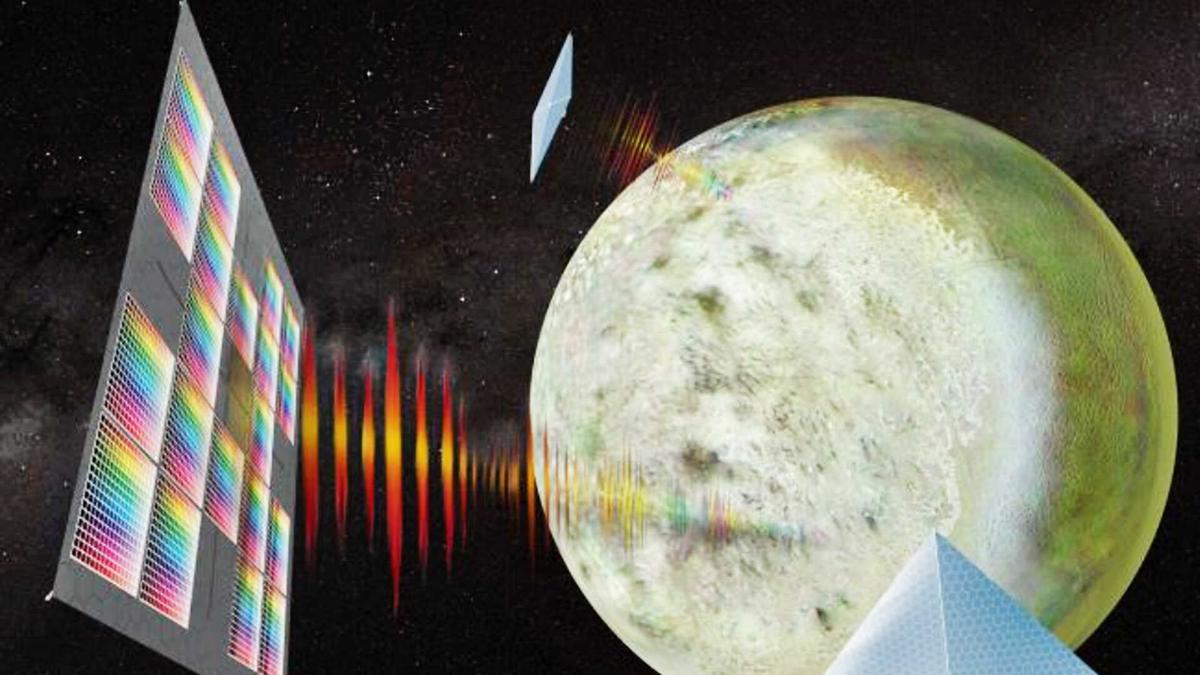
NASA’s exploration of the outer solar system, particularly the ice giants Neptune and Uranus, has been limited due to the high cost, long travel time, and narrow launch windows associated with these missions. However, a mission concept called SCOPE (ScienceCraft for Outer Planet Exploration) aims to address these challenges and unlock the secrets held by these distant worlds.
Developed by NASA aerospace engineer Mahmooda Sultana, SCOPE integrates a science instrument and spacecraft into a single, lightweight structure called a ScienceCraft. The ultra-lightweight quantum dot-based spectrometer is printed directly onto a solar sail. That leaves a lot of room in terms of mass to put additional components that are required to operate the spacecraft. The result is a spacecraft architecture that allows for data collection, as well as rapid travel across the solar system. Spectroscopy is the study of the absorption and emission of light by matter – to explore the outer solar system scientifically
The second aspect involves utilizing ‘extreme solar radiation’. ScienceCraft gets close to the sun, at about 0.2 – 0.3 Astronomical Unit (AU), where there is a high solar radiation density. The closer to the Sun the spacecraft is, the higher the impact of the solar radiation density. This pushes the ScienceCraft ahead that it reaches outer planets in just three to five years.
Unlike conventional solar sails that serve only to propel small cubesats, SCOPE utilizes its large surface area for spectroscopy, pushing the boundaries of scientific exploration in the outer solar system. This innovative approach offers a low-resource platform that can enable science missions at a significantly lower cost and provide numerous launch opportunities as a secondary payload.
One of the primary targets for SCOPE is Triton, a unique moon of Neptune. The mission aims to reach Triton within a short window that closes around 2045, allowing scientists to answer compelling questions about its atmosphere, ionosphere, plumes, and internal structure.
During Phase I of the project, the SCOPE team conducted an end-to-end feasibility study for a Neptune-Triton mission using a ScienceCraft, identifying key technologies and potential challenges. In Phase II, they plan to further refine the mission concept, develop and demonstrate key technologies, address the challenges identified in Phase I, and create a roadmap for implementing SCOPE.
Use of Solar sails could offer a new approach to space exploration wherein missions could be both low-cost and fast-transit. According to recent studies, solar sails could reach speeds greater than 10 AU/year making exploration of the outer solar system possible.