


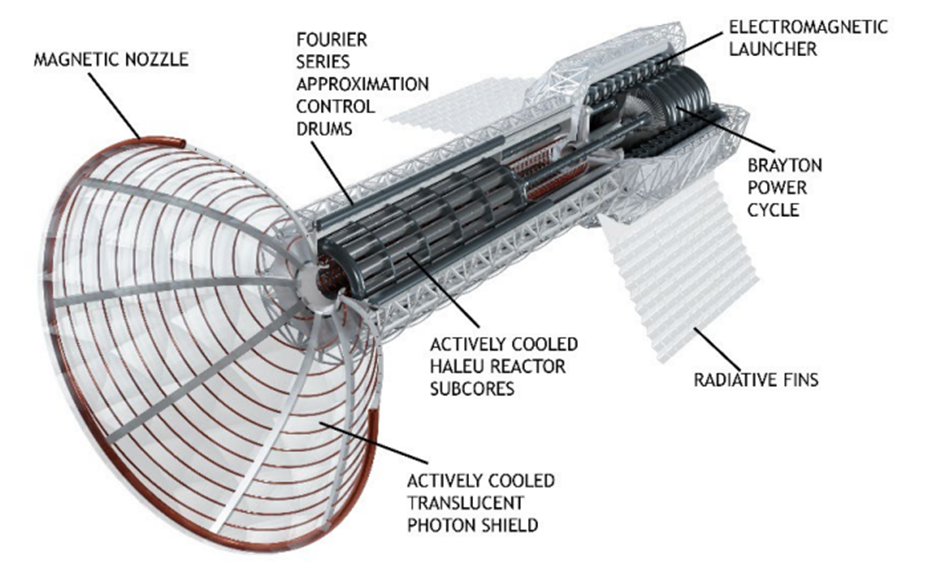
A promising new propulsion system called the Pulsed Plasma Rocket (PPR) is being developed by Howe Industries. This innovative technology utilizes plasma, the fourth state of matter, to generate high-efficiency propulsion for spacecraft. The Pulsed Plasma Rocket (PPR) is originally derived from the Pulsed Fission Fusion concept, but is smaller, simpler, and more affordable. https://www.nasa.gov/general/pulsed-fission-fusion-puff-propulsion-concept/
Our world is usually broken down into three states of matter: solid, liquid and gas. When matter is cold, it is solid. As it heats up, it turns into a liquid. When more heat is applied, you get a gas. As you add even more heat, you get — plasma! The extra energy and heat break apart the neutral atoms and molecules in the gas into typically positively charged ions and negatively charged electrons. Plasma, for all its scarcity in our daily lives, makes up more than 99 percent of the observable matter in the universe (that is, if we discount dark matter).
Plasma technology has also been used in rockets to help us get around outer space, and it holds the most promise for getting humans to places we could only dream of before. These rockets need to be in the vacuum of outer space to work since the density of air near the earth’s surface slows down the acceleration of the ions in the plasma needed to create thrust, so we can’t actually use them for lift-off from earth.
A NASA-funded NIAC (NASA Innovative Advanced Concept) Phase I study focused on using the PPR for a large, heavily shielded ship to transport humans and cargo to Mars. The study assessed the system’s neutronics, spacecraft design, power system, subsystems, magnetic nozzle capabilities, and trajectories. Phase II will build upon these assessments and further develop the PPR concept.
The PPR combines high specific impulse (Isp), a measure of how efficiently an engine generates thrust, and high thrust, potentially generating up to 100,000 N of thrust with an Isp of 5,000 seconds. To put this into perspective, current chemical rockets typically have an Isp of around 300-400 seconds. This level of efficiency could revolutionize space exploration, enabling manned missions to Mars in as little as two months. The technology also allows for the transport of heavily shielded spacecraft, reducing crew exposure to harmful galactic cosmic rays during long-duration missions. In addition to Mars missions, the PPR could be used for exploring other distant destinations.