


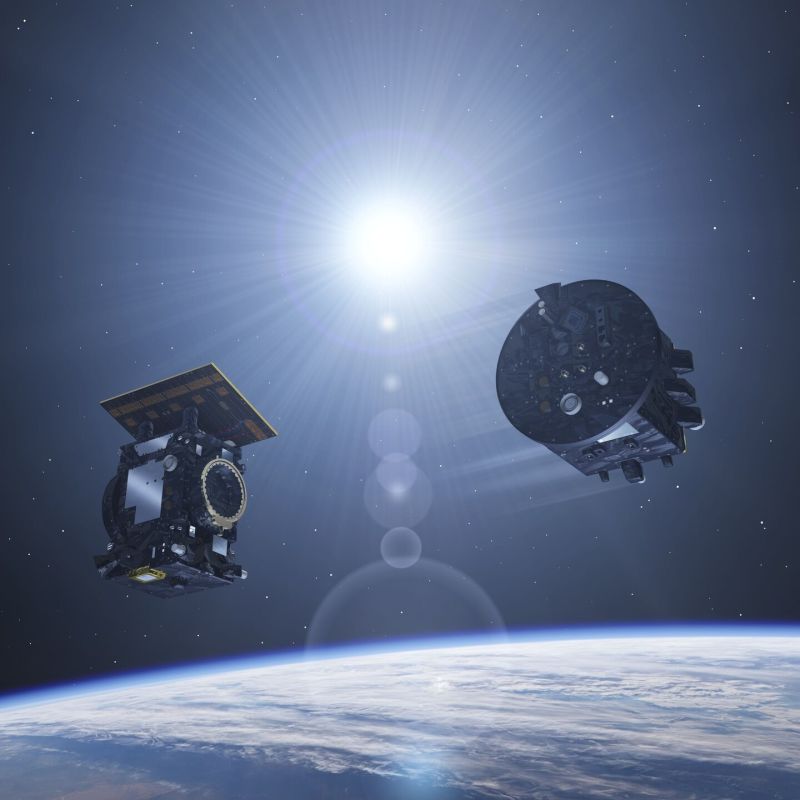
The European Space Agency (ESA) is set to launch Proba-3, the fourth mission in its PRoject for On-Board Autonomy (PROBA) series. This mission aims to demonstrate precise formation flying techniques and technologies while observing the Sun’s corona over a two-year period.
Proba-3 consists of two spacecraft – a coronagraph and an occulter – operating in a highly elliptical orbit. These satellites will function as a virtual telescope, maintaining a precise 150-meter separation during scientific operations near the orbit’s apogee. This unprecedented level of precision will enable detailed studies of the Sun’s corona closer to its surface than ever before.
The mission’s innovative design includes a radio-based inter-satellite link system developed by @Tekever in Portugal. This system will be one source to continuously update the range between the two spacecraft throughout their orbit, ensuring accurate positioning and communication.
Proba-3’s objectives extend beyond solar observation. Each orbit will serve as a space laboratory, demonstrating various manoeuvres including acquisition, rendezvous, proximity operations, formation flying, and convoy flying. These repetitive demonstrations will validate crucial technologies, guidance systems, and control algorithms previously tested only in ground simulators.
Key to the mission’s success is the validation of relative GPS navigation and metrology instruments essential for formation flying. Additionally, Proba-3 will conduct rendezvous experiments to test sensors and algorithms for both cooperative and uncooperative scenarios in elliptical orbits.
Predicting the relative motions of two spacecraft to such high precision is a complex computational task which usually requires powerful processors. This was a challenge to implement within the relatively modest processing power capability of Proba-3’s onboard computers. ESA and the industrial teams developed an onboard control algorithm based on innovative simplifications of the relative orbit model which allows it to run on the onboard computers.
High-precision formation flying has many applications. Future in-orbit servicing or satellite refueling missions will need to safely approach existing satellites. During Sample Return missions, two spacecraft will meet in orbit to exchange samples from the surface without navigational support from global satellite navigation systems available at Earth and with a long communication delay for any commanding from Earth. This rendezvous will need to be carried out by highly accurate and autonomous onboard navigation systems which are being tested with this mission.