


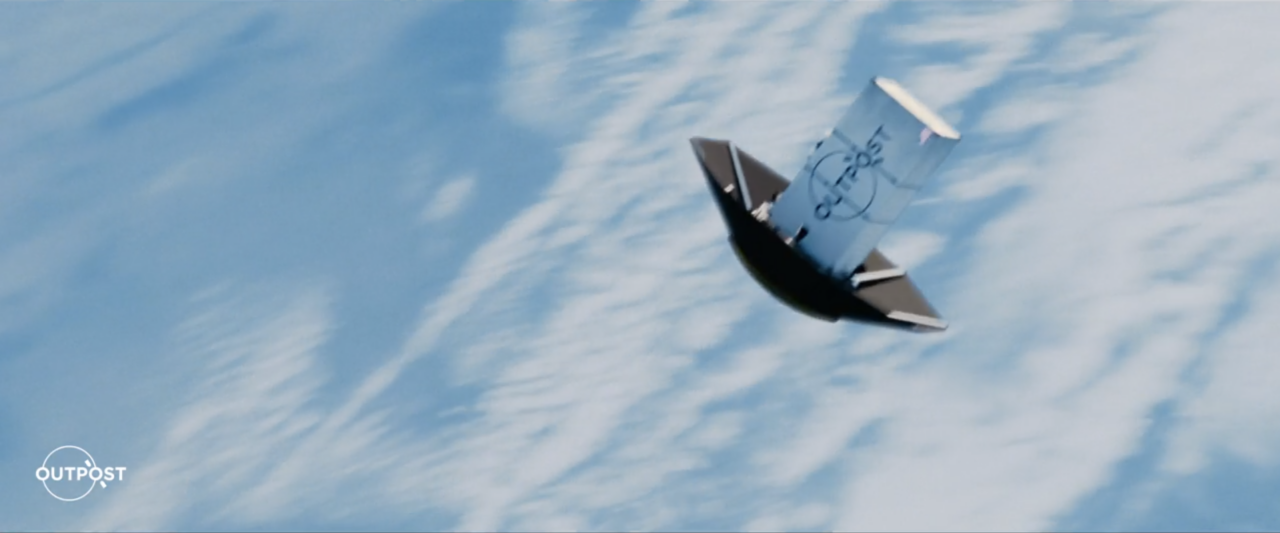
@Outpost is developing a novel solution for returning cargo from orbit, addressing the growing need for efficient space-to-Earth logistics. The company’s journey began with a focus on safely bringing space debris back to Earth and has evolved into an ambitious plan to revolutionize orbital cargo return.
Outpost’s latest venture involves launching shipping container-sized spacecraft called Carryall into orbit. These vehicles are designed to advance in-space manufacturing and research by providing a more efficient cargo return capability than traditional methods.
The Carryall system combines several technologies to achieve its goals. It features a satellite bus for orbital maneuvering, a deployable heat shield made of 3D woven carbon fiber, and a robotic paraglider for precise landings. This approach allows for a significantly higher payload capacity compared to traditional capsule-based return methods.
This approach allows for a significantly higher payload capacity compared to traditional capsule-based return methods. The system’s reentry process involves several stages:
– In orbit, Carryall unfolds its heat shield and orients for reentry.
– The heat shield protects the payload and slows the vehicle to subsonic speeds.
– At 30 km altitude, a drogue parachute deploys for stabilization.
– At 20 km, a robotic paraglider takes over for precise point-to-point delivery.
Outpost’s system has the potential to reduce costs and increase the volume of materials that can be returned from orbit. This could open up new possibilities for space-based manufacturing and experimentation, as well as contribute to reducing space debris.
The company has partnered with NASA to develop the Cargo Ferry, which will be used to return things from commercial space stations and the ISS. The company plans to launch its first smaller-scale mission, Ferryall, in early 2026, with the full-sized Carryall potentially following in 2027.
As the space economy grows, Outpost’s innovative approach could play a significant role in shaping the future of space logistics and manufacturing. However, success will depend on overcoming the technical challenges associated with orbital operations and atmospheric reentry.