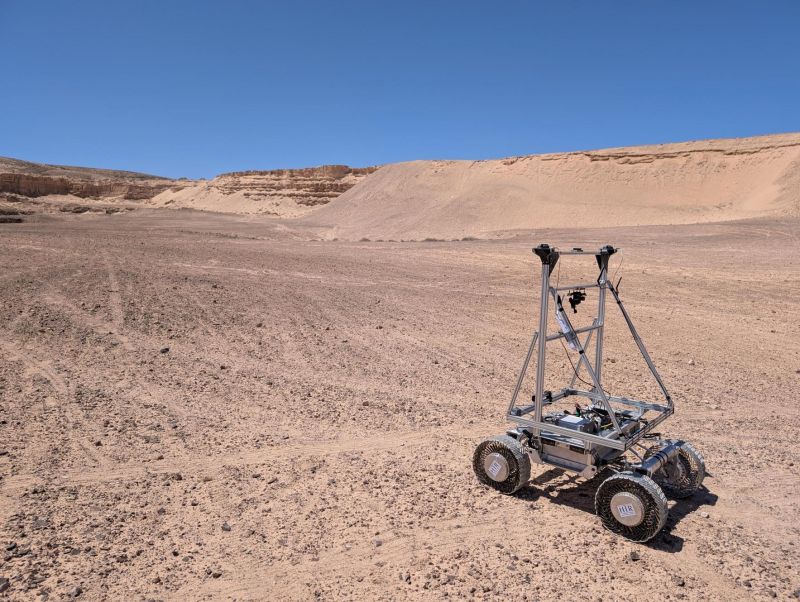
Co-funded by the European Space Agency – ESA as part of its Navigation Innovation and Support Program (ESA NAVISP), GMV’s LUPIN (Enabling High-Performance PNT in the Lunar Environment) project focuses on developing prototype autonomous navigation technology that uses simulated signals lunar rovers will receive from future Lunar Communication Navigation Systems (LCNS) like Moonlight. The aim is to test new positioning, navigation, and timing (PNT) technologies that will be able to support exploration of the lunar surface and other applications. This technology will combine current approaches to planetary PNT with distance measurement signals from the future LCNS.
The project recently did field testing from April 27th to May 8th in La Oliva, Fuerteventura, where GMV successfully validated their real-time navigation system across diverse simulated lunar conditions. Over seven kilometers of testing at speeds ranging from conventional 0.2 meters per second to ESA’s required minimum of 1.0 meters per second, the team demonstrated the system’s capability across various environments, including nighttime operations with simulated lunar illumination and complete darkness scenarios using only onboard lighting.
Current lunar rovers depend heavily on complex onboard algorithms for relative positioning, which limits their operational efficiency and speed. LUPIN’s approach reduces this computational burden, allowing surface conditions rather than technical limitations to constrain the rover speed. This advancement enables lunar missions to allocate more payload capacity to scientific instruments rather than navigation subsystems, while companies planning lunar operations will benefit from standardized positioning services.
Navigating the Moon: LUPIN Project Charts New Course for Autonomous Lunar Exploration