


Recognizing that space is now an integral component of present-day society, the Royal Society has recently completed a report that explores the potential implications of space activities by 2075, aiming to stimulate discussion without predicting specific outcomes. Martin Sweeting from SSTL has summarized the report and this is a shortened version of his summary with focus on space exploration.
Humanity’s historical expansion from land to sea and air now extends into outer space. The coming decades will see increased exploration beyond near-Earth orbit, with potential long-term bases on the Moon and Mars. Advances in large reusable rockets, single-stage-to-orbit spaceplanes, and green propellants will lower costs and increase orbital access, enabling large-scale orbital manufacturing and reducing constraints on spacecraft size.
Space-based power systems could support orbital factories and data centers while transmitting clean energy to Earth. Recycling technologies developed for space stations may benefit terrestrial applications, while lunar or asteroid resource extraction could create a circular space economy. However, this increased activity necessitates international agreements on space traffic management and debris minimization, similar to initiatives like the Astra Carta.
Robotic and autonomous systems will continue to lead space exploration, preparing environments for human activity. Orbital research platforms could exploit microgravity to develop advanced materials, pharmaceuticals, and biological products. On the Moon, autonomous robots powered by solar or nuclear energy could mine resources and build infrastructure, including subsurface bases for radiation protection. These facilities could serve as hubs for scientific research and gateways for deeper Solar System exploration.
Technologies developed for lunar bases could enable Martian facilities, though Mars’ distance demands greater operational independence. The possibility of individuals born on the Moon or Mars raises questions regarding nationality and physiological adaptation. By 2075, planetary sciences and astrobiology may clarify whether life exists beyond Earth, yielding profound scientific and philosophical insights.
International collaboration remains vital for safe, productive, and equitable space use, despite growing competition for orbital slots and radio frequencies among state and non-state actors. Space activities are accelerating globally, particularly within the private sector. New Space companies have accelerated innovation in the space sector, such as microsatellite pioneers Sir Martin Sweeting. Early awareness of long-term trends will help society prepare for challenges and make informed choices to sustainably benefit from Earth and space environments.
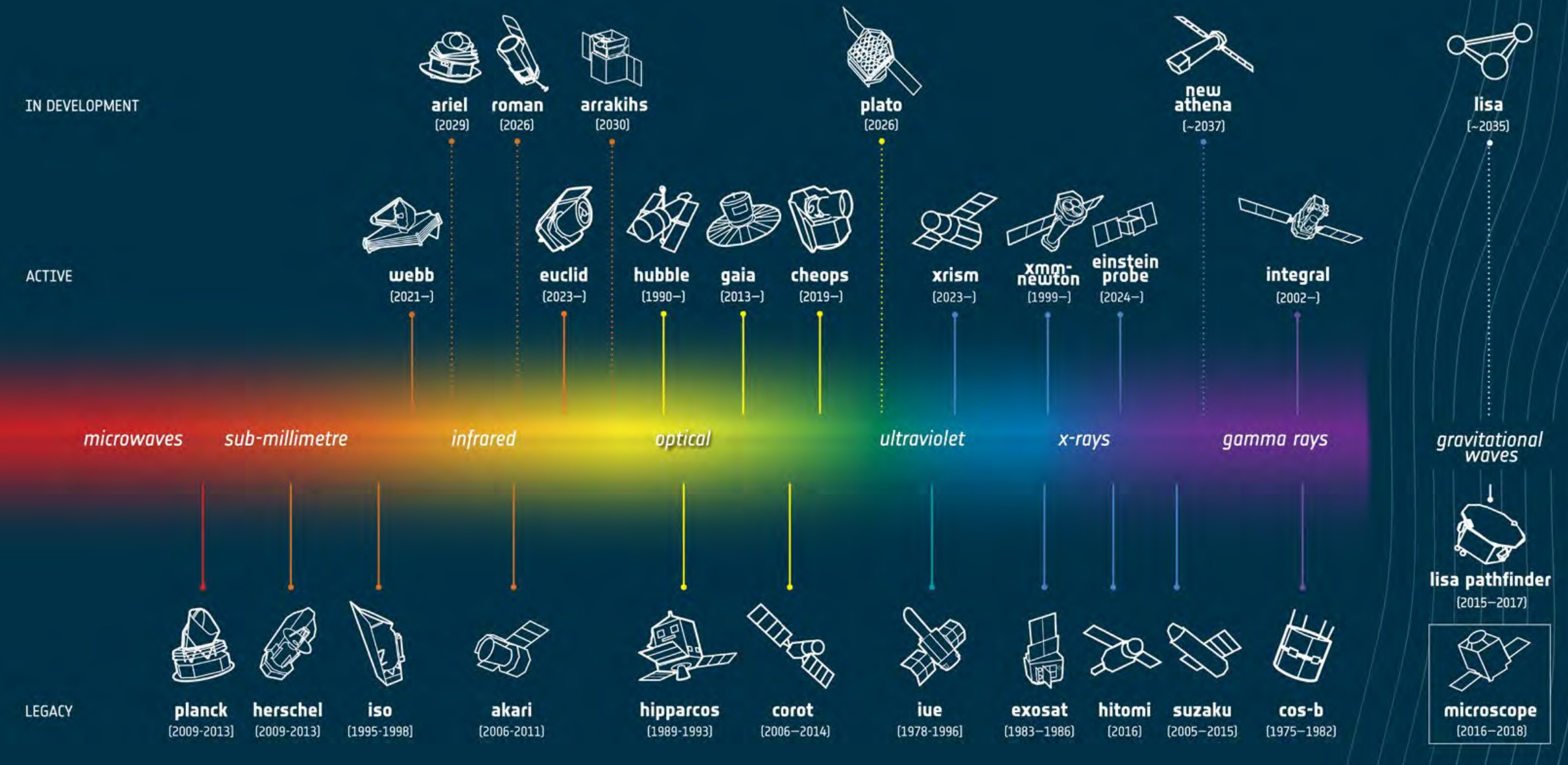
Image Credit: ESA – Illustrations showing the current state of ESA’s astronomy missions, inc. collaborative missions
Reference
SpaceNews – “A Perspective on Space: Preparing for 2075.” https://spacenews.com/a-perspective-on-space-preparing-for-2075/
The Royal Society – “Space 2075 Report.” https://royalsociety.org/-/media/policy/projects/space2075/space-2075-report.pdf
Martin Sweeting wiki https://en.wikipedia.org/wiki/Martin_Sweeting