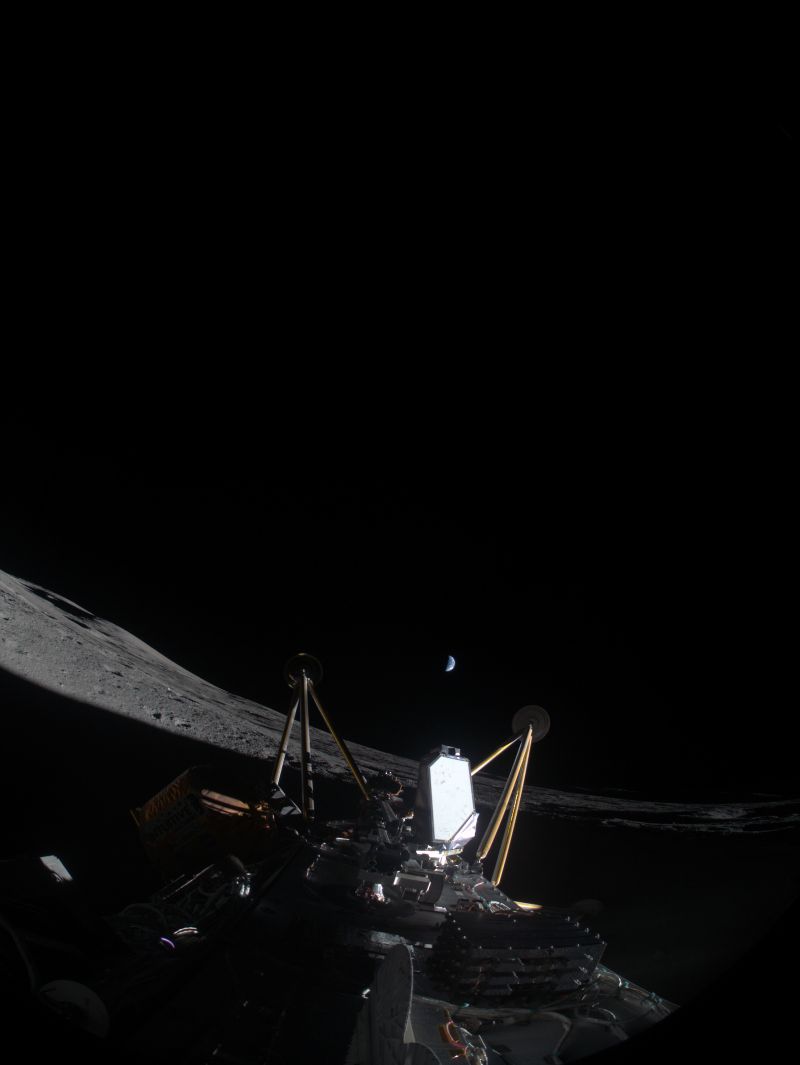
For the second time in just over a year, Intuitive Machines‘ lunar lander ended up on its side after touchdown due to the same critical sensor that affected its predecessor Odysseus—a laser rangefinder that left the spacecraft without accurate data during its final descent phase.
Despite meticulous preparation following the first mishap, where the laser rangefinder was not activated and an alternative NASA Navigation Doppler Light Detection and Ranging (LIDAR) payload was activated, the Intuitive Machines (IM) engineering team found itself facing a troublingly familiar scenario. As the lander Athena approached within 30 kilometers of the lunar surface, the laser-based altimeters began producing noisy readings. The team had thoroughly checked and re-checked these systems, yet the issue resurfaced at the critical moment.
This problem points to a potential gap in mission planning: the absence of alternative navigation systems.. While Athena’s in-house propulsion system performed admirably, the spacecraft couldn’t overcome its navigation challenges without alternatives to the laser rangefinder. The repeat of laser-based sensor issues raises serious questions about how thoroughly lessons from Odysseus were implemented, suggesting future lunar missions must incorporate redundant navigation technologies to ensure mission success.
Athena, landed 250 meters from its intended landing site in the Mons Mouton region of the lunar south pole, inside of a crater. Images downlinked from Athena on the lunar surface confirmed that Athena was on her side. With the direction of the sun, the orientation of the solar panels, and extreme cold temperatures in the crater, IM does not expect Athena to recharge. The mission has therefore sadly prematurely concluded with some exciting payloads never getting the chance to touch the lunar surface:
–Intuitive Machines‘ Micro Nova Hopper, nicknamed “Gracie,” was supposed to be the first propulsion based hopping vehicle to explore the lunar surface.
–Lunar Outpost Mobile Autonomous Prospecting Platform (MAPP) rover and some other small rovers planned to do lunar prospecting
As lunar exploration accelerates globally, this mission is a reminder of the challenges at the southern pole region – characterized by rugged terrain, extreme temperatures, and limited direct Earth communication. While this setback represents a challenge for IM, it exemplifies the inherent risks of New Space which thrives on an iterative approach where each mission contributes valuable engineering insights to subsequent designs – though perhaps the lessons from Odysseus weren’t integrated as comprehensively as they could have been into Athena’s systems.
Lunar Lander Déjà Vu: Intuitive Machines’ Second Attempt to Land on the Moon Also Went Sideways Due to a Laser Rangefinder Issue