


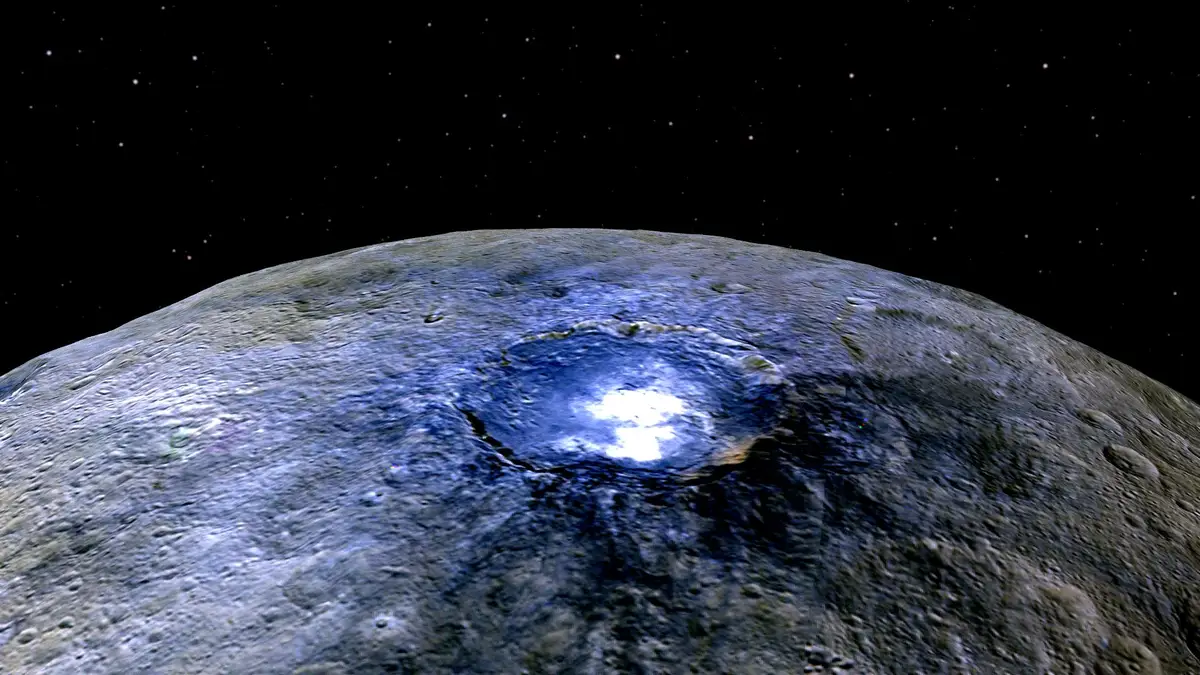
@Luleå University of Technology is spearheading an ambitious project called CALICO (Ceres Autonomous Lander Into Crater Occator) to investigate the potential for past or present life on the dwarf planet Ceres. Ceres is the largest planet in the asteroid belt between Mars and Jupiter, and it is the only dwarf planet located in the inner solar system. The proposed mission, which involves landing a spacecraft on Ceres to analyze its surface material, has been selected by the @European Space Agency (ESA) for further study.
Ceres, classified as an ocean world, has garnered significant scientific interest due to the possibility that it once harbored conditions supportive of life. The presence of organic material and abundant salts on its surface, likely originating from the interior, could provide valuable insights into the chemistry of life’s early stages in the solar system.
CALICO aims to land in Ceres’ Occator crater, where salt-rich deposits suggest recent eruptions of subsurface brines. Using state-of-the-art instruments from leading European research institutes, the mission will conduct comprehensive analyses of the surface material’s chemistry, mineralogy, geology, and physics. Additionally, the mission will search for signs of aqueous activity and potential subsurface liquids, which are considered prime candidates for habitability in the outer solar system.
CALICO brings together an international consortium of over 80 researchers. If selected as ESA’s final candidate in 2029, with a possible launch in 2036 or 2037, the mission could enhance our understanding of the solar system’s origin, evolution, and the potential for extraterrestrial life.
Image Source: NASA/JPL-Caltech/UCLA/MPS/DLR/IDA – A colorized view of Occator Crater on dwarf planet Ceres, the largest object in the Asteroid Belt, as seen by NASA’s Dawn probe.