


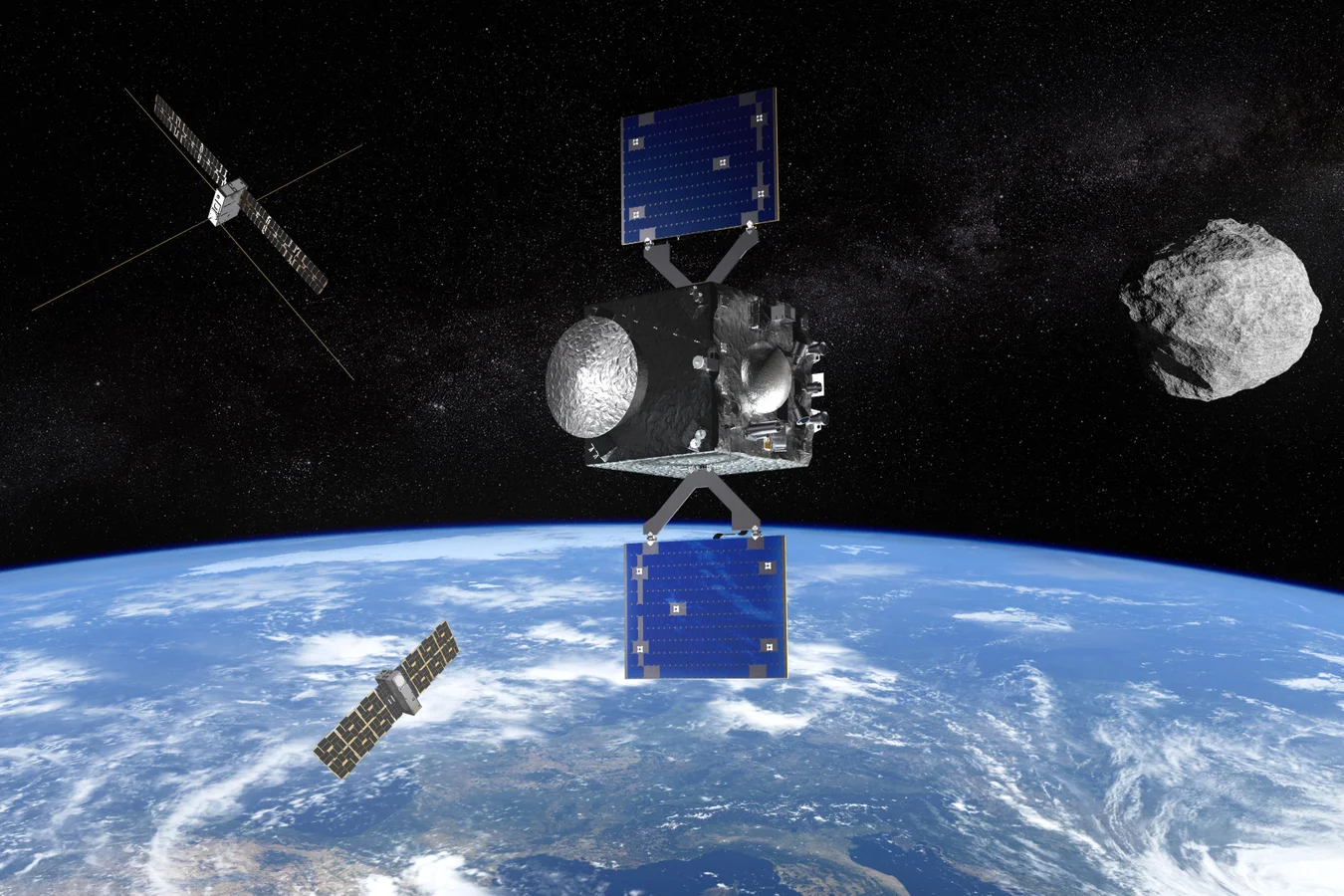
In the realm of space exploration, few events capture the imagination quite like a close celestial encounter. On April 13, 2029, asteroid 99942 Apophis, named after the Egyptian god of chaos and destruction, will pass within 32,000 km of Earth—closer than some telecommunications satellites in geostationary orbit and visible in the night sky to the naked eye from parts of Europe, Africa and Asia. This rare flyby presents an unprecedented opportunity for scientific discovery and planetary defense research.
Enter the European Space Agency’s Rapid Apophis Mission for Space Safety (RAMSES). This ambitious project, named after an Egyptian pharaoh, aims to rendezvous with Apophis before its Earth approach and accompany it during the flyby. Ramses will provide invaluable data on how Earth’s gravity affects the asteroid, potentially triggering surface changes and altering its rotation.
Why is this mission crucial? While Apophis poses no impact threat for at least the next century, studying it up close will enhance our understanding of asteroid composition, structure, and behavior. This knowledge is vital for developing effective planetary defense strategies against potential future threats.
Ramses faces a tight timeline, with a planned launch in April 2028 to reach Apophis by February 2029. The mission will conduct comprehensive before-and-after surveys of the asteroid’s properties, offering insights into how celestial bodies respond to gravitational forces. Ramses would reuse a lot of the technology, teams and expertise developed for ESA’s Hera mission (https://www.esa.int/Space_Safety/Hera) , which would minimize its development time and cost. Like Hera, Ramses would carry with it two CubeSats, which it would deploy once it has arrived at Apophis, and which would carry an advanced suite of instruments of their own.
NASA, meanwhile, has redirected its OSIRIS-REx spacecraft (https://www.linkedin.com/posts/tolgaors_asteroidsample-planetaryscience-samplereturn-activity-7201500070838472704-tdkv) towards Apophis. Due to the limits of orbital mechanics, the newly renamed OSIRIS-APEX will arrive at Apophis roughly one month after the asteroid’s Earth flyby. OSIRIS-APEX will approach the surface of the asteroid and fire its engines to kick up loose rocks and dust and offer scientists a peek at the material just below the surface.
The Ramses mission exemplifies the importance of rapid reconnaissance in planetary defense. It demonstrates our growing capability to quickly deploy spacecraft to incoming celestial objects—a crucial first step in protecting Earth from potential impacts. While for Apophis we’re encouraging everyone to “look up,” this mission helps ensure we never end up in a real-life “Don’t Look Up” scenario.