


Blue OriginNew Glenn’s second mission, NG-2, launched Thursday, November 13, from Cape Canaveral to send NASA’s EscaPADE twin spacecraft to Mars. Also onboard was a technology demonstration from Viasat.
𝐌𝐚𝐢𝐧 𝐎𝐛𝐣𝐞𝐜𝐭𝐢𝐯𝐞: 𝐄𝐬𝐜𝐚𝐏𝐀𝐃𝐄
The Escape and Plasma Acceleration and Dynamics Explorers (EscaPADE) mission critical spacecraft were provided by Rocket Lab. Space Sciences Laboratoryat the University of California, Berkeleyserved as the main developer of the scientific equipment and will be leading science mission. EscaPADE represented a milestone in affordable Mars exploration, aiming to investigate the interaction between the solar wind and the Martian atmosphere at a fraction of the cost of traditional missions. The twin spacecraft each weigh 524 kilograms, with the science payload itself accounting for just eight kilograms. The journey covers 10-11 months and a distance of 370 million kilometers to the Red Planet. This is the first multi-spacecraft science mission to Mars.
Rocket Lab, primarily known for its Electron launcher, also develops spacecraft platforms. The mission deployed twin spacecraft, Blue and Gold, based on Rocket Lab’s Explorer platform.
𝐕𝐢𝐚𝐬𝐚𝐭 𝐈𝐍𝐑𝐀𝐍𝐆𝐄 𝐃𝐞𝐦𝐨𝐧𝐬𝐭𝐫𝐚𝐭𝐨𝐫
The mission also carried the Viasat INRANGE Demonstrator, a rapid implementation of space-based range technology for launch telemetry in support of NASA – National Aeronautics and Space Administration‘s Communications Services Project. Viasat’s user terminal and InRange solution were integrated onto and remained attached to the New Glenn launch vehicle. The objective was to support NASA’s aim to transition orbital communication users from NASA’s Tracking and Data Relay Satellite (TDRS) system to commercial SATCOM solutions.
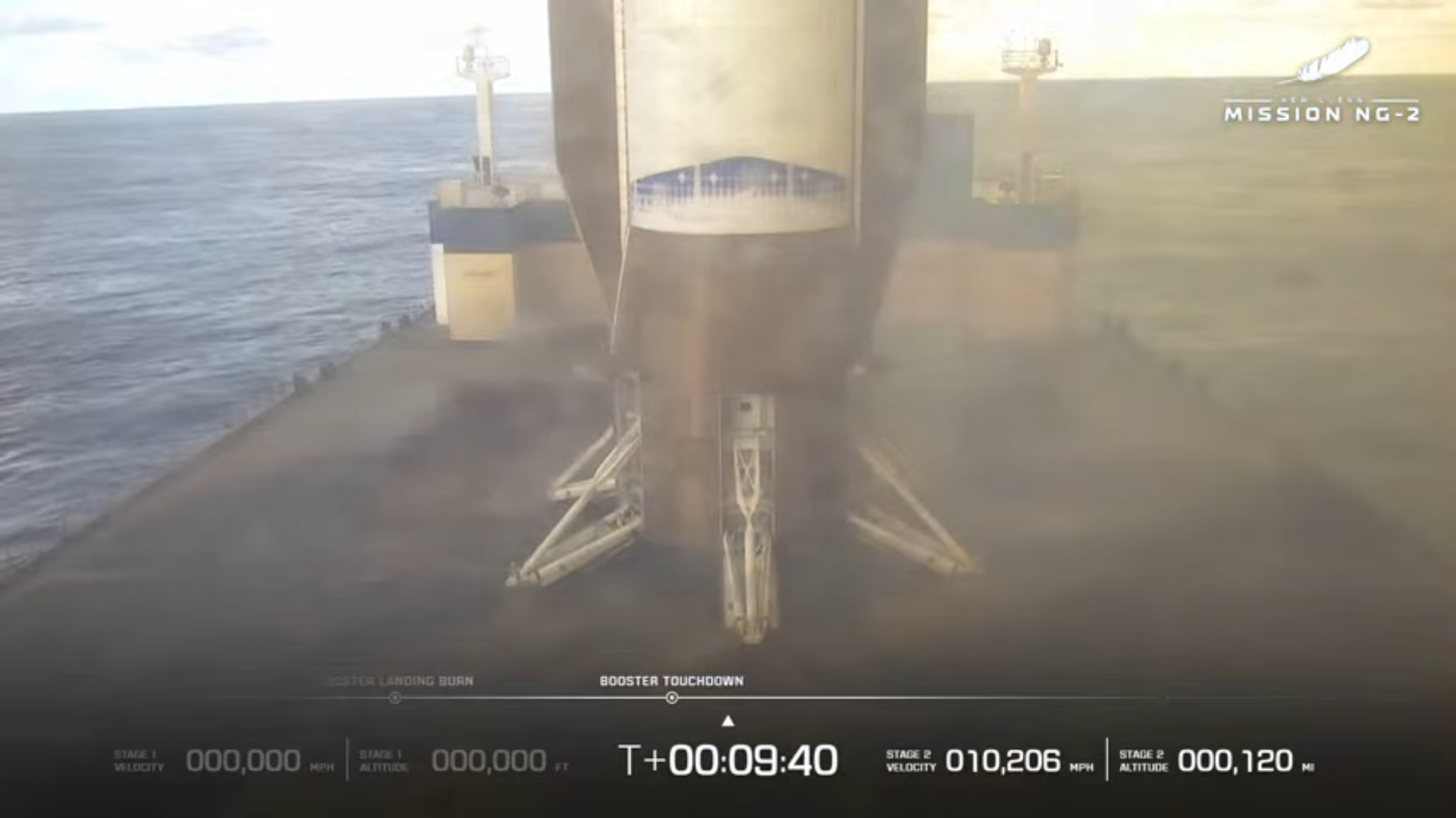
Today’s launch was the second to date for New Glenn, which can haul about 50 tons of payload to Low Earth Orbit (LEO). The rocket debuted with a successful test flight on January 16, 2025, which sent a prototype version of Blue Origin’s Blue Ring spacecraft platform to orbit. The company failed in its attempt to land New Glenn’s first stage on a ship at sea that day. This time the booster landing attempt succeeded.
Sunday’s launch demonstrated how New Glenn expands capabilities within the New Space economy. By providing heavy-lift capacity, Blue Origin’s launcher complements the small-lift capabilities offered by companies like Rocket Lab’s Electron, enabling more New Space companies to launch payloads to space. This mission exemplified how commercially developed launchers and spacecraft can work together with a space agency and academia on a science mission, a great example of public-private partnership.
Image Credit: Blue Origin – NG-2 Booster after landing