Keeping astronauts healthy and nourished on long-duration space missions remains a challenge. Fresh food is difficult to produce beyond Earth, but scientists are turning to an ancient drink—kefir—to help solve the problem. Kefir is a fermented milk beverage made using symbiotic grains of yeast and bacteria. For centuries, it has been valued across cultures for its probiotic properties, providing beneficial microbes that support gut health, immunity, and overall well-being.
Historians believe kefir originated centuries ago in the Caucasus Mountains in Eastern Europe near present-day Türkiye. Kefir may ultimately be linked to an Old Turkic root “köpür” meaning ‘to foam or froth’, reflecting the characteristic bubbly, effervescent texture of the fermented milk drink.
Analog astronauts tested daily kefir production during a lunar analog mission at HI-SEAS (Hawaii Space Exploration Analog & Simulation) habitat located on the slopes of Mauna Loa volcano. During the six-day mission, a team of international analog astronauts, led by NASA scientist Katherine Fisher and mission chief scientist Tuğçağ DUMLUPINAR, successfully fermented kefir using simple materials: powdered milk and fluorinated ethylene propylene (FEP) bags. This continued NASA’s BioNutrients-3 experiments conducted by researchers at NASA Ames Research Center.
The crew produced continuous generations of kefir, each cultured from the previous batch, and monitored fermentation with a color-coded pH indicator. Laboratory analysis later confirmed the kefir met standard acidity and showed no contamination, demonstrating that astronauts can safely create fresh probiotic food in a controlled, resource-limited environment.
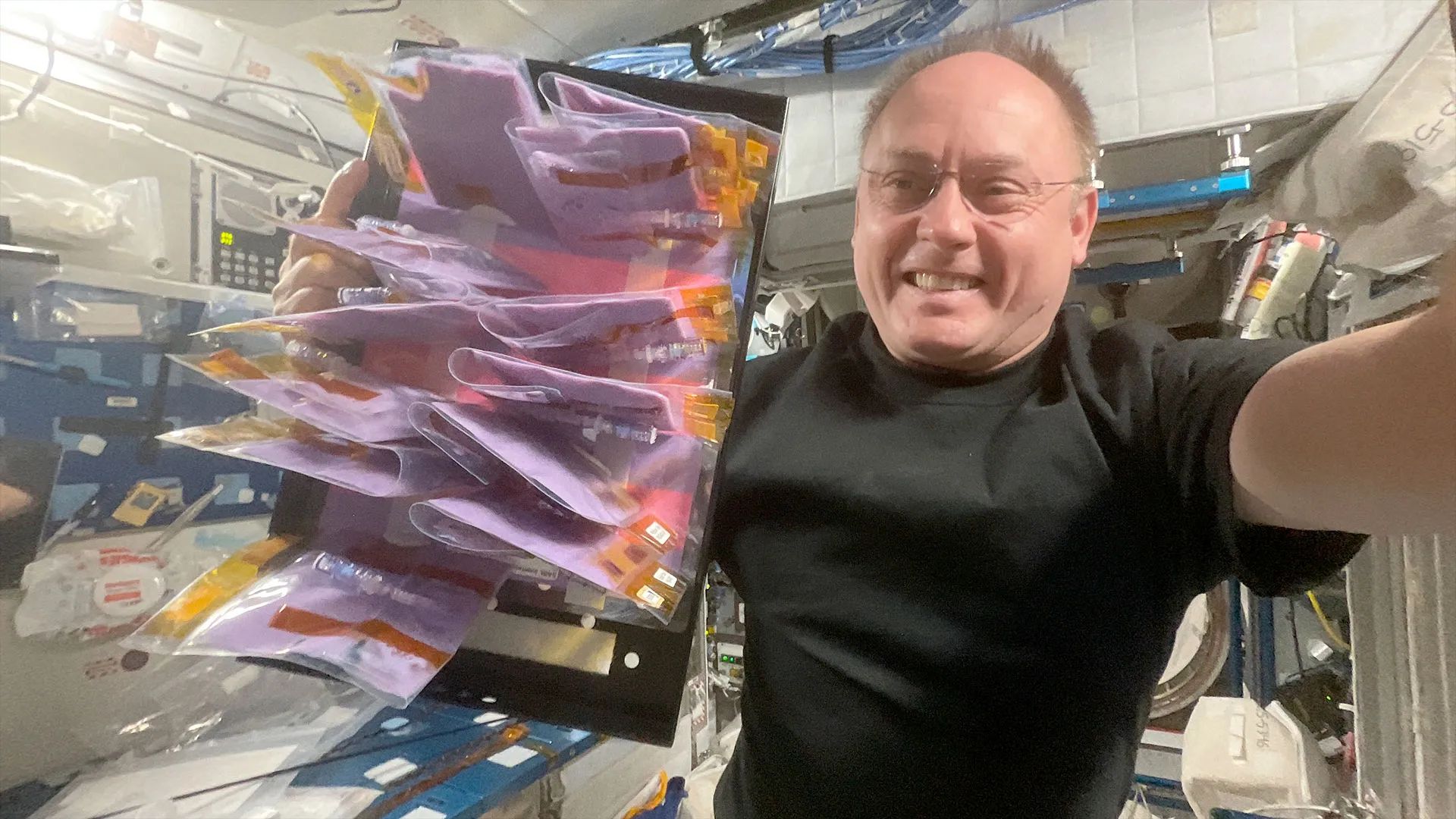
Beyond the analog environment, the same experiment was conducted at the ISS by astronaut E. Michael Fincke as part of BioNutrients-3, testing ways to use microorganisms to produce nutrients off Earth and on demand. Fincke used a research incubator to test yeast, yoğurt, and kefir samples to produce vitamins and nutrients for future crews’ health. The astronaut showed off a tray of purple kefir used in the experiment, shown below.
This project addresses a critical need for astronaut health on long-duration missions and future journeys to the Moon and Mars, establishing microbial food systems for sustainable nutrient production in future space habitats. On Earth, similar fermentation methods could help remote communities or disaster relief teams generate essential nutrients without supply chains.
Image Credit: NASA/Mike Fincke – Expedition 73 flight engineer Mike Fincke holds up a tray of purple kefir (fermented milk) as part of a bio-nutrients experiment on the International Space Station.
Kefir in Space: Ancient Fermentation for Future Astronaut Nourishment