


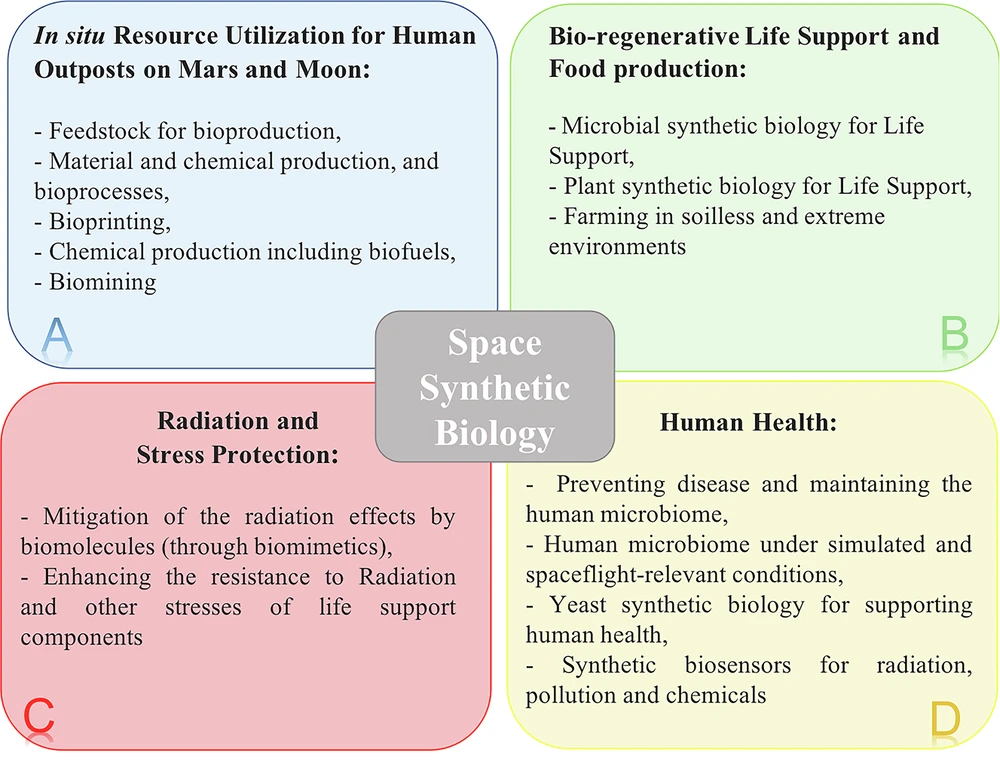
As humanity prepares to return to the Moon and eventually reach Mars, one critical issue is how to keep people alive, healthy, and self-sufficient far from Earth. Synthetic biology, the engineering of biological systems for specific purposes, is quietly emerging as one of the more practical solutions to this challenge.
The European Space Agency’s 2023 SciSpace White Paper identified four areas where engineered organisms could meaningfully contribute to deep space missions. The first is In-Situ Resource Utilization (ISRU): rather than launching every kilogram of material from Earth, microorganisms could extract metals from regolith, produce building materials through microbially-induced calcite precipitation, or convert asteroidal carbon into useful products. Mass savings of up to 85% compared to conventional approaches have been estimated for some applications — a figure that matters enormously in mission planning.
Bioregenerative life support represents a second critical area. Engineered bacteria, fungi, algae, and plants could form closed-loop systems capable of recycling waste into food, regenerating oxygen, and purifying water. The concept of transferring Earth’s plant-microbiome relationships to hydroponic systems in space, potentially using Martian or lunar regolith as a growth substrate, is already being explored.
Radiation protection is a third frontier. Mars surface exposure runs at roughly 100 to 200 times the radiation on Earth and interplanetary transit adds further risk. Radioresistant microorganisms such as certain cyanobacteria and fungi produce antioxidant pigments like melanins and carotenoids that could be developed into dietary supplements or composite shielding materials. Finally, for crew health, engineered yeasts could serve as on-demand pharmaceutical factories, producing antibiotics, analgesics, or vaccines, while biosensor bacteria embedded in the gut microbiome could monitor astronaut health in near real-time.
These possibilities come with genuine risks that deserve equal attention. Gene-edited organisms released into extraterrestrial environments could disturb ecosystems we don’t yet understand, or contaminate sites of potential scientific value. This is the domain of Planetary Protection — the international framework designed to prevent biological contamination of other worlds, and of Earth upon return. As the Committee on Space Research (COSPAR) has noted, the use of living organisms in ISRU and life support systems raises questions that current planetary protection policies are only beginning to address.
Synthetic biology for space exploration is not a distant concept — it is an active research agenda. The challenge ahead is advancing it responsibly, with biosafety frameworks that keep pace with the science.
Image Credit: Synthetic biology for space exploration paper
References:
Synthetic biology for space exploration
https://www.nature.com/articles/s41526-025-00488-7#Bib1
Article advisor @Lucas Boldrini
Synthetic biology for peaceful uses of outer space
https://blog.igem.org/blog/2023/4/5/q1prqwvrgiramrnwyj8hp3m9tdu3zr
The SciSpacE White Papers
iGEM Space Initiative
https://technology.igem.org/technologies/space
BioMoon: A microbial bio-stimulant to grow vegetables on lunar soil