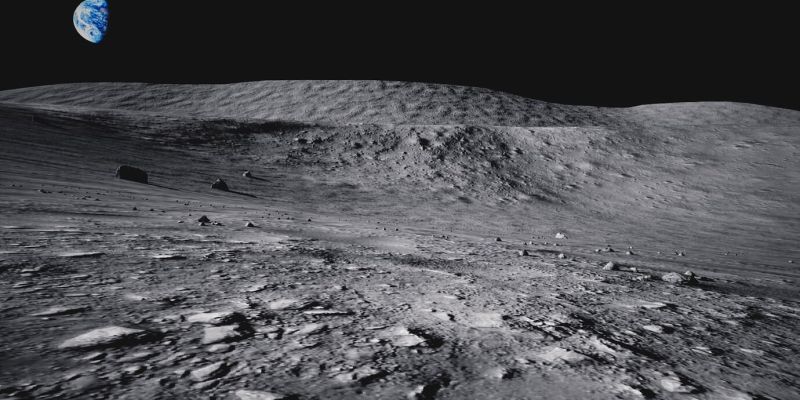
A pioneering comprehensive digital twin of the Moon is now taking shape through a collaboration agreement between ispace, inc. and Spacedata Inc., announced on March 7, 2025.
At its core, the digital twin will serve as a high-fidelity topographical model built using actual lunar data acquired during ispace’s exploration missions. This virtual replica extends beyond surface mapping to incorporate the unique physics of the lunar environment, including gravity effects and communication delays.
The technology addresses a fundamental barrier in space exploration: the prohibitive costs and inherent risks of lunar testing. By creating an accurate testing ground, the partnership enables verification of rover operations and technology demonstrations in a simulated environment before deployment in actual missions.
Another technical achievement SpaceData plans is to democratize the “knowledge of space physics” previously accessible only to specialists by providing technology to compute and visualize fluid-rigid body interactions and physical phenomena in various space environments such as Low Earth Orbit, the Moon and Mars.
This collaboration establishes a foundation for the expanding Cislunar economy by creating new business opportunities and fostering international cooperation between space agencies and private companies. The digital twin provides a shared environment where diverse stakeholders can test concepts, verify operations, and collaborate on lunar initiatives.
As space exploration transitions from primarily government-led endeavors to include more private ventures in the New Space economy, SpaceData’s digital twin addresses practical challenges that have historically constrained commercial lunar missions. For emerging space companies with limited capital reserves, this high-fidelity simulation platform offers a cost-effective risk-mitigation strategy, also benefiting lunar lander navigation systems that require extensive testing before deployment.
The technology reduces technical barriers to entry by providing standardized verification frameworks that space startups can leverage for developing lunar systems. The underlying architecture is designed to adapt for future digital twins of the new space station, Mars, and other celestial bodies, creating a consistent testing methodology that supports companies developing multi-destination technologies while maintaining technical continuity across different operating environments.
How SpaceData’s Digital Moon Will Be Transforming Lunar Exploration