


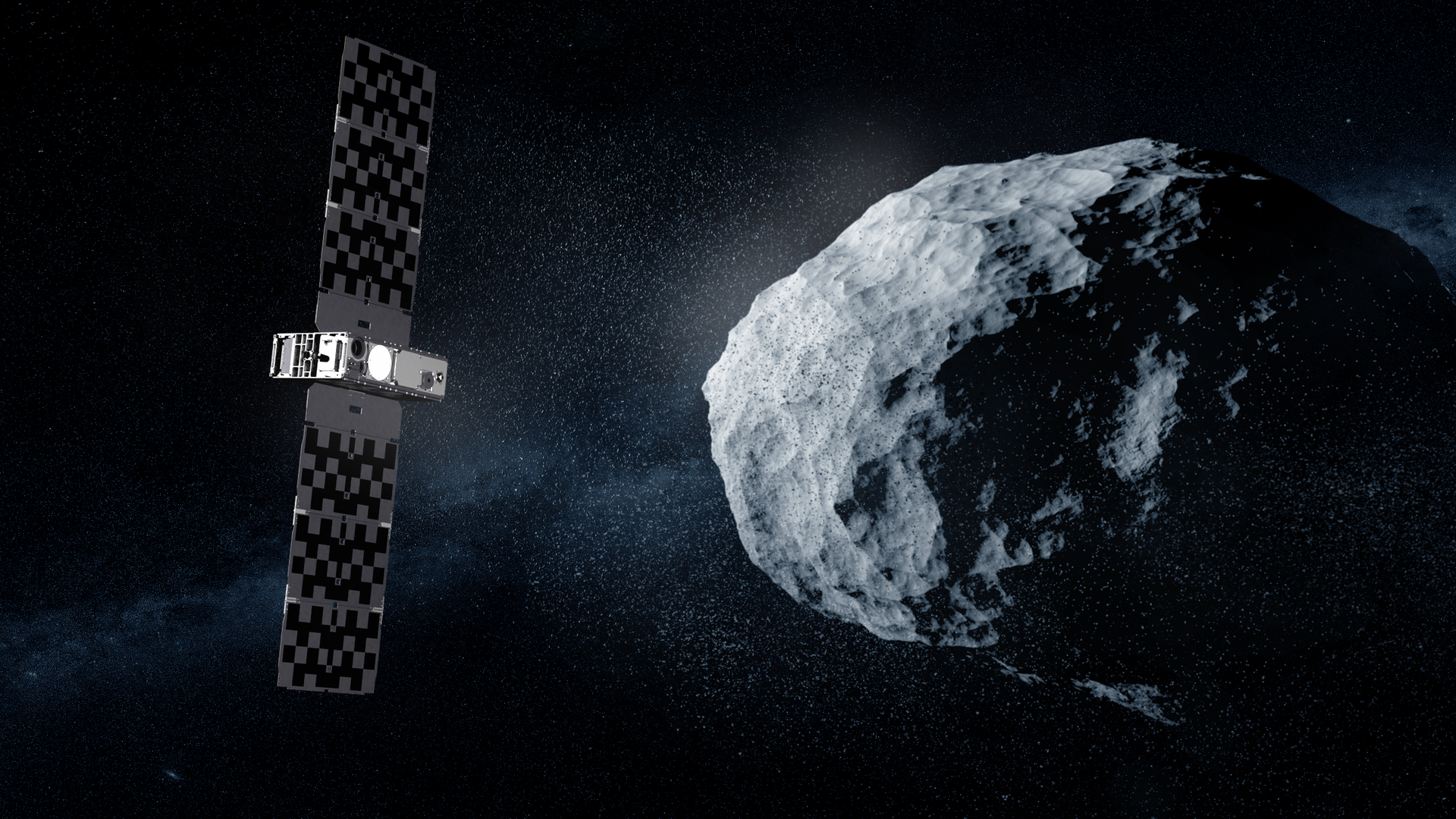
The Hera mission, part of the ESA-NASA AIDA collaboration (https://www.linkedin.com/posts/tolgaors_planetarydefense-asteroidmission-nearearthobject-activity-7221849257014657024-inVZ), will deploy two shoe-box sized 6U CubeSats near the Didymos binary asteroid system. The Milani CubeSat was named after Andrea Milani, who was a planetary defence pioneer who first devised what became ESA’s Near Earth Object Coordination Centre.
Equipped with full 6-DOF maneuvering capabilities, Milani will operate autonomously post-deployment. Its primary scientific instrument, the ASPECT hyperspectral imager, will conduct detailed surface mapping of both Didymos and Dimorphos. ASPECT’s spectral range allows for comprehensive characterization of surface properties, including space weathering, shock effects, evidence of surface material transfer, and surface roughness. Additionally, Milani carries a Volatile In-Situ Thermogravimetre Analyser (VISTA) instrument for detecting the presence of dust particles smaller than 5-10 μm; to detect volatiles (e.g., water) and monitoring the molecular contamination in support of other instruments on-board cubesats or satellites. It will also contribute to Hera’s radio-science experiment, aiding in the characterization of Didymos’ gravity field.
Milani will utilize an Inter-Satellite Link (ISL) for communication with Hera and Juventas (the second CubeSat), establishing the first spacecraft-CubeSat network in an asteroid environment. This ISL will facilitate data relay and support coordinated operations. Hera will be used to communicate with ground stations on Earth.
Following its main objectives, Milani will enter an Experimental Phase, attempting autonomous navigation and even a landing on Dimorphos. Developed by a European consortium led by @Tyvak International and funded by the @Agenzia Spaziale, Milani showcases the potential of low-cost, high-return interplanetary CubeSat missions in expanding our understanding of near-Earth asteroids.