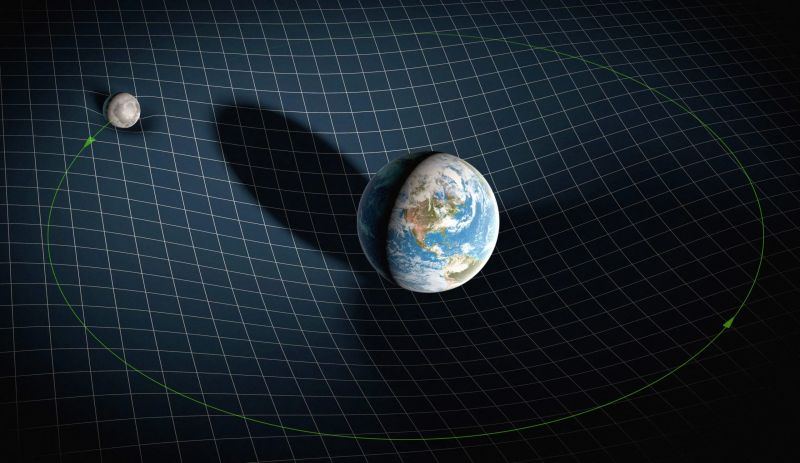
The Moon’s gravitational field serves as a fundamental navigation map for spacecraft operating in cislunar space and future lunar landers. A recent study based on the PhD thesis ofAlexander Berne published in Nature [1] demonstrates how NASA’s GRAIL mission has transformed our understanding of lunar gravity through an unprecedented five-year data analysis effort.
The Moons gravitational field changes with the periodic tidal forcing due to its eccentric and oblique orbit around the Earth. This changing lunar gravity field and is also sensitive to our natural satellite’s internal structure. The Gravity Recovery And Interior Laboratory (GRAIL) mission was designed to investigate the Moon’s interior structure and advance the knowledge of its history of heat flow by mapping the Moon’s variations in its gravity field to high precision. Between 2011 and 2012, two GRAIL satellites—Ebb and Flow—collected precise gravitational measurements as they orbited the Moon at altitudes as low as 23 kilometers. Processing raw data represented an enormous computational challenge: solving for 3.24 million parameters to create the highest-resolution lunar gravity field model ever achieved.
The data processing required a super-computers using 700 Haswell nodes, which has 20 cores with 128 GB of memory per node working continuously, generating a 39-terabyte information matrix. This intensive analysis revealed something unexpected: the Moon’s internal structure shows significant asymmetry between its near and far sides, with temperature differences of 100-200 Kelvin still persisting from ancient volcanic activity that occurred 3-4 billion years ago. The uneven mass distribution, as a result of the temperature difference, creates gravitational variations that spacecraft experience, affecting their trajectories.
This enhanced gravity model provides critical benefits for mission planning. Spacecraft navigating cislunar space require precise gravitational maps to maintain stable orbits and execute efficient trajectory corrections. For lunar landers, understanding local gravitational variations can mean the difference between successful touchdown and mission failure.
The new model enables more accurate predictions of spacecraft behaviour near the Moon, reducing fuel consumption and improving mission reliability. The five-year investment in data processing has created a foundation that will support decades of lunar exploration. Each mission now benefits from this comprehensive gravitational model framework, making space operations safer and more predictable as humanity establishes a sustainable presence beyond Earth.
GRAIL Mission Reveals Most Accurate Time-Varying Lunar Gravity Field Model: Five Years of Data Processing Unlocks Navigation Framework for Future Missions