


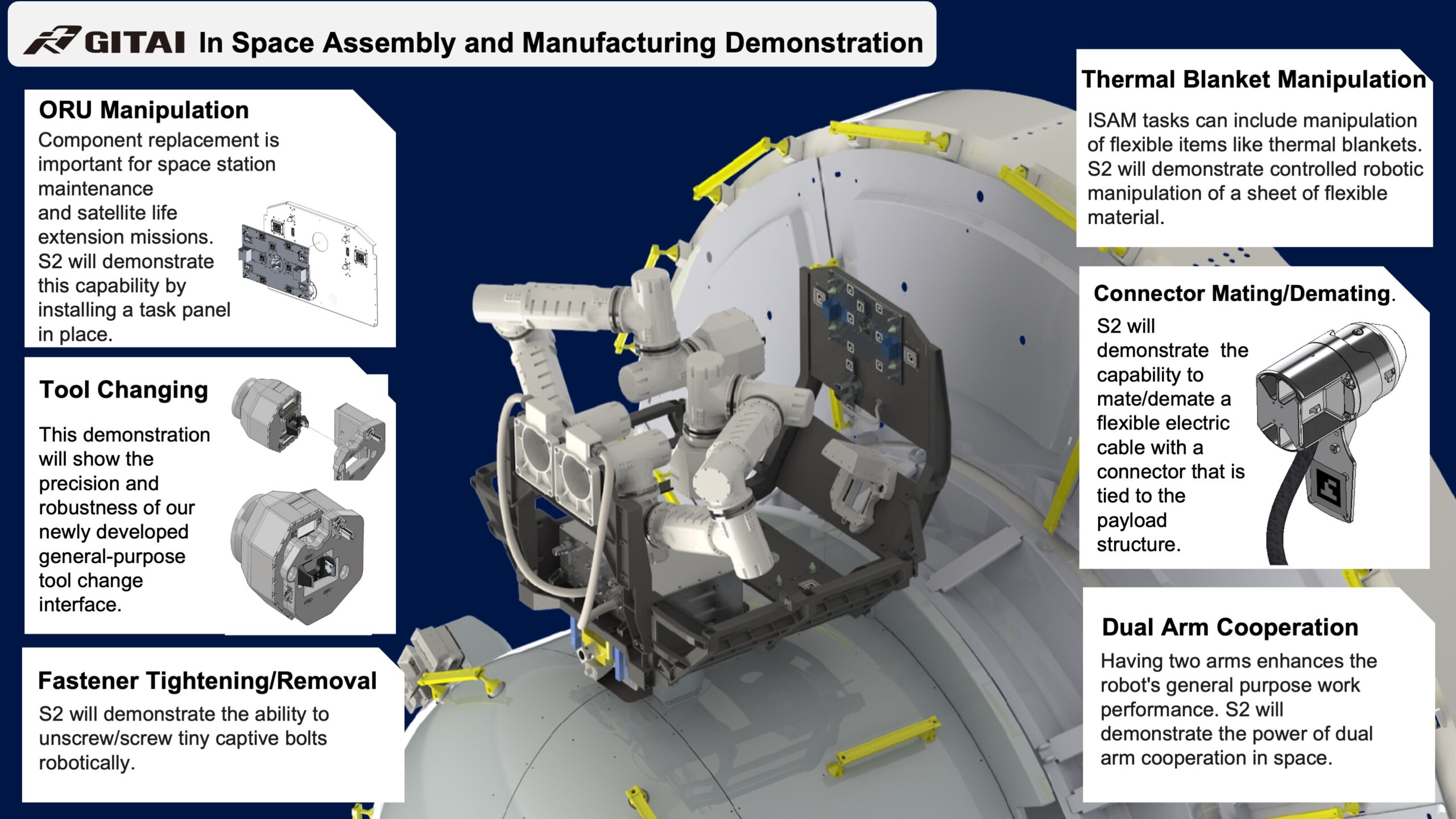
GITAI’s S2’s extraveHicular multi-Objective in-Space servicing Task (GHOST) demonstration represents a significant progress in space robotics. This initiative demonstrates the capabilities of the “S2” variant of GITAI’s 2-meter class Modular Robotic Arm and extravehicular robotic system.
The S2 system, an autonomous dual robotic arm, has completed a series of experiments that expand the possibilities for in-space operations. These achievements contribute to the development of commercial space activities, including plans for long-term lunar presence and sustainable on-orbit servicing infrastructure.
Project GHOST has advanced GITAI’s extravehicular robotic system to NASA’s Technology Readiness Level (TRL) 7. This progress allows both public and private sectors to consider using robust, high-performance robotics for space stations, on-orbit services, and potential lunar installations through GITAI’s Robotics as a Service (RaaS) program.
The S2 system mounted external to the ISS on the Nanoracks Bishop airlock has performed six key tasks :
1. Orbital replacement unit (ORU) manipulation
2. Tool changing
3. Screw tightening and removal
4. Connector mating and demating
5. Thermal blanket manipulation
6. Dual arm cooperation
These tasks, executed via “supervised autonomy,” (semi-teleoperation/semi-autonomous) with a human operator in Nanoracks’ BRIDGE (mission control room). These semi-automated tasks represent in-space assembly and manufacturing operations essential for advancing commercial space stations, on-orbit servicing, and lunar city construction programs.
As part of its evaluation, the S2 is undergoing an on-orbit endurance test. Three of its 14 actuators operate continuously for a six-month period, which is comparable to multiple years of actual operation on a space station, spacecraft, or lunar base.
While GITAI’s S2 system is primarily designed for space operations, it may have applications on Earth as well. The technology could potentially be adapted for use in extreme terrestrial environments, such as disaster relief operations, deep-sea excavation, and servicing nuclear power plants. The capabilities demonstrated in space suggest that this technology could be valuable for addressing challenges in demanding environments on Earth. GITAI’s S2 system contributes to the advancement of space exploration and commercialization while also presenting possibilities for enhancing operations in challenging conditions on our own planet.