


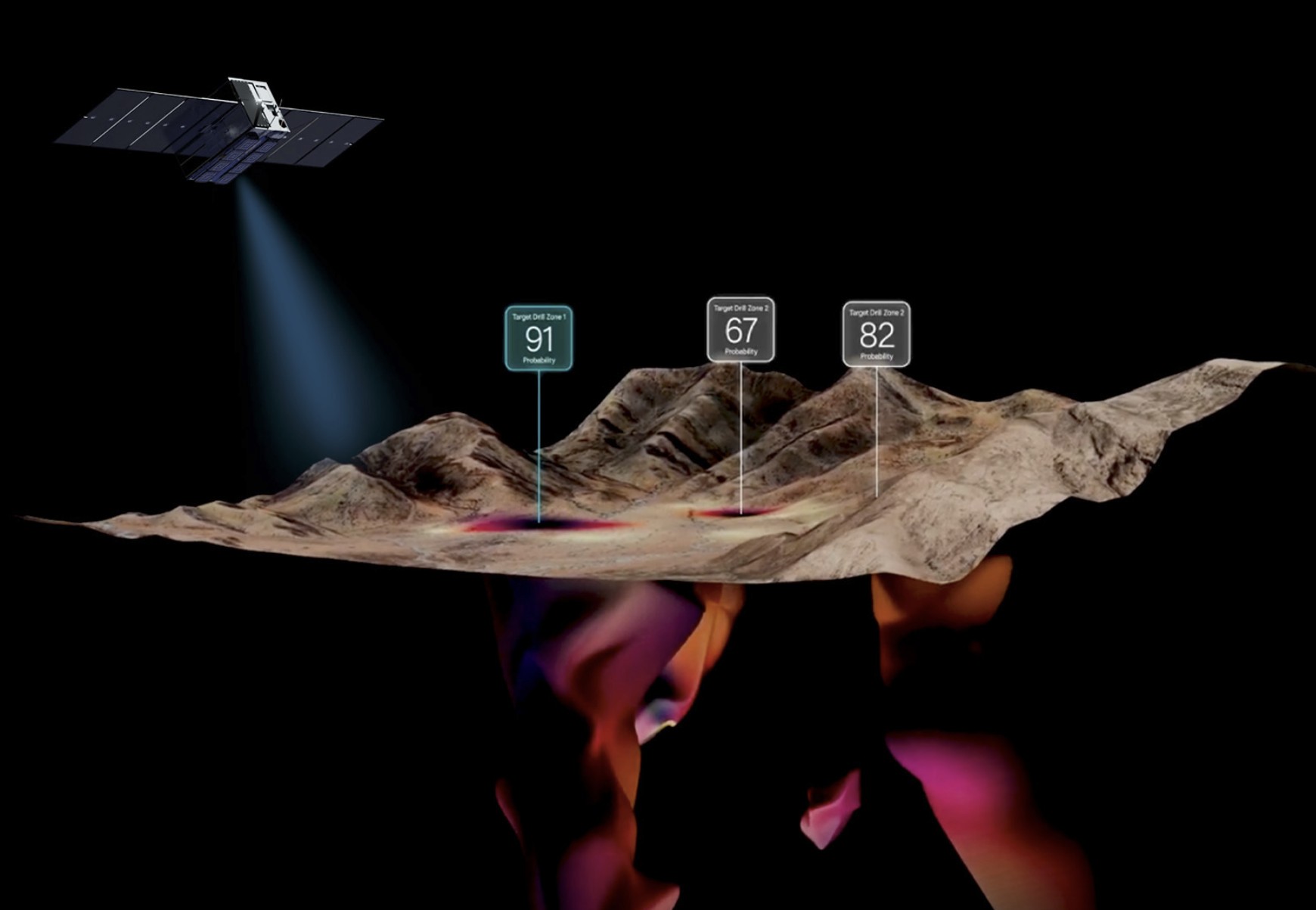
Fleet Space, an Australian space technology company, is redefining mineral exploration through its Quantum Innovation Pipeline, driven by three new partnerships that bring cutting-edge physics into the field. Building on its ExoSphere satellite-enabled seismic sensing system, Fleet is integrating advanced quantum detectors that deliver faster, more precise subsurface imaging with minimal environmental impact. The partnerships with mDetect, Nomad Atomics, and DeteQt represent a new wave of Australian-led innovation:
mDetect applies muon tomography, using naturally occurring cosmic particles to generate 3D density maps of the subsurface. This passive technique provides deep, high-resolution insights for mineral targeting without invasive drilling.
Nomad Atomics develops high-precision quantum gravimeters and accelerometers. Their drift-free measurements generate ultra-fine gravity data, improving the predictive power of Fleet’s exploration models.
DeteQt pioneers diamond-on-chip quantum magnetometers. These portable sensors detect vector magnetic fields with extreme sensitivity and can be scaled for widespread deployment, enabling real-time conductivity models with minimal ground disturbance.
Together, these technologies expand Fleet’s toolkit beyond seismic imaging, creating a versatile platform for Earth and space exploration. ExoSphere is already deployed by more than 50 exploration companies worldwide, replacing costly drilling with a low-impact, satellite-enabled seismic solution. Fleet’s innovations have attracted strong investor confidence, including a recent $100 million Series D funding round valuing the company at $525 million.
Looking ahead, Fleet’s ambitions extend beyond Earth. Its SPIDER payload, developed under Australia’s Moon to Mars initiative, will fly on Firefly Aerospace’s Blue Ghost lunar mission in 2026. As the first Australian seismic technology on the Moon, SPIDER will probe the South Pole’s subsurface for geological structures and potential water ice — vital knowledge for future human exploration.
By uniting advanced quantum sensing with proven space-based systems, Fleet Space is positioning Australia at the forefront of critical mineral discovery and planetary science. The Quantum Innovation Pipeline demonstrates how strategic partnerships can unlock faster, more sustainable exploration — on Earth and beyond.
Dr. Gerrit Olivier, CSO at Fleet Space, puts it plainly: “The same toolkit is being readied for off-planet prospecting. Compact quantum sensors and muon detectors will fly on upcoming asteroid-scout missions, allowing humanity to map the interior structure and resource potential of metal-rich bodies that were impossible to reach until recently. Whether on Earth or in deep space, the combination of high-fidelity physics and continuously learning AI is redefining how quickly and sustainably we can locate the critical minerals that power the global energy transition.”
References:
Fleet Space – Quantum Innovation Pipeline: https://www.fleetspace.com/newsroom/fleet-space-builds-quantum-innovation-pipeline-for-next-gen-mineral-exploration
SpaceNews – Fleet Space raises $100M: https://spacenews.com/fleet-space-raises-100-million-to-advance-mineral-exploration-on-earth-and-beyond
Fleet Space – SPIDER lunar mission: https://www.fleetspace.com/newsroom/fleets-lunar-seismic-technology-heads-to-the-moon-on-fireflys-blue-ghost-lander