As we set our sights on establishing a permanent human presence on the Moon, one of the most intriguing prospects lies beneath its surface: lunar caves. These natural formations could provide ready-made shelters for future lunar inhabitants, protecting them from harsh radiation, meteorite impacts, and extreme temperature fluctuations.
The European Space Agency – ESA took a significant step forward in 2019 for lunar cave exploration with their SysNova Lunar Caves Challenge. This innovative initiative culminated in two winning proposals that have since been merged into a comprehensive exploration system: DAEDALUS (Descent And Exploration in Deep Autonomy of Lava Underground Structures) and RoboCrane.
The Daedalus is a spherical payload for lunar cave exploration. It consists of two main structures, the external and the internal. The outer structure is a polyimide sphere that protects the instruments and electronics from dust contamination, while being transparent for wavelengths relevant for the instruments. The inner structure hosts the avionics and the instruments. Four optical cameras with hemispherical lenses provide a panoramic field of view around the sphere. Four LIDARs (a set of 2 on opposite sides) will be used to create a 3D point cloud of the pit during descent. By combining the rotation of the scanning mirrors with the rotation of the sphere, 360°. Additionally, the LIDARs operate at two different wavelengths which allows the detection of volatiles coatings and water ice on basalts.
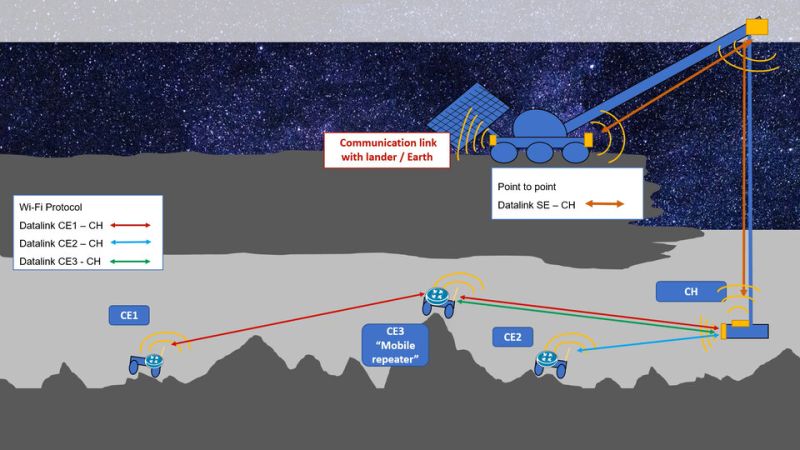
Complementing DAEDALUS is the RoboCrane system, which serves as the crucial link between the surface and underground operations. This deployment mechanism includes stabilizing outriggers, a counterweight system, and a protected mast container that shields equipment from lunar dust during transport. The system’s “Head” component not only deploys DAEDALUS but also provides vital power, data connectivity, and thermal management. The RoboCrane’s versatility extends further, as its “Head” can also provide wireless charging and communication capabilities for additional rovers in the exploration setup.
This integrated approach to lunar cave exploration could provide a significant advancement in our capabilities to understand and utilize lunar subsurface structures. The exploration of lunar caves isn’t just about scientific discovery – it’s about enabling humans next giant leap in space exploration. By understanding and utilizing these caves, we will be one step closer to establishing a permanent human presence on our natural satellite and beyond.
Exploring the Moon’s Hidden Shelters to Determine Suitability for Human Habitation