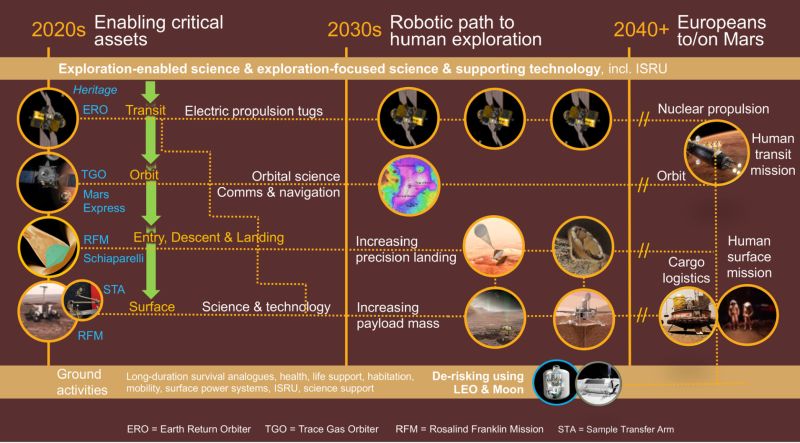
The European Space Agency – ESA‘s Explore2040 presents a Mars exploration strategy, building upon decades of scientific achievements while recognizing the complexities of interplanetary missions. This strategic initiative, which emerged from the Seville 2023 Space Summit, reflects Europe’s desire to establish continuous, sustainable, and responsible human and robotic exploration of the Solar System by providing unique contributions to benefit society.
The Mars strategy introduces an integrated exploration model that connects robotic missions with future human expeditions. The Rosalind Franklin rover mission serves as Europe’s key scientific Mars endeavor, focusing on the search for potential biological signatures on and below the Martian subsurface. In addition, Europe will also fly the Earth Return Orbiter (ERO) using an electric propulsion space tug as part of the Mars Sample Return campaign. This international partnership will return scientifically-selected samples from Mars to Earth.
For surface missions, the next steps will focus on building key strategic capabilities for Entry, Descent and Landing (EDL) of payloads with increasingly higher precision and mass. Eventually, more advanced EDL will deliver heavy logistics landing, including power, habitation, and mobility, as will be required to establish a human presence on the surface of the Red Planet.
For orbital and surface missions, the next-generation electric propulsion space tugs, with the potential to evolve towards nuclear propulsion, will help lower the costs, leading to more frequent missions carrying ever larger payloads between Mars, the Moon and Earth.
Leveraging the space tug capabilities, orbital precursor missions will carry scientific payloads to identify the most interesting scientific areas and help bring about safe precision landing due to a better environmental knowledge through understanding the Martian atmosphere and terrain. The addition of orbital communications and navigation systems in the early orbital missions, will significantly improve the capability of successive missions.
While Explore2040 reflects Europe’s commitment to responsible space exploration and technological competitiveness, the emerging NewSpace ecosystem presents complementary pathways. These innovative companies propose mission architectures that could potentially achieve similar objectives at significantly lower costs. Adopting a diversified approach that includes both traditional and NewSpace solutions could reduce mission risks by avoiding single points of failure in large-scale missions. This balanced strategy combines scientific objectives with practical considerations, establishing a foundation for European contributions to humanity’s expansion into the solar system.
Europe’s Pathway to Mars: A Strategic Vision for Sustainable Space Exploration