


Swiss team EPFL Xplore won the European Rover Challenge again. Watching their rover on the Marsyard, the precision of its movements was obvious even from the sidelines and I predicted they may win again.
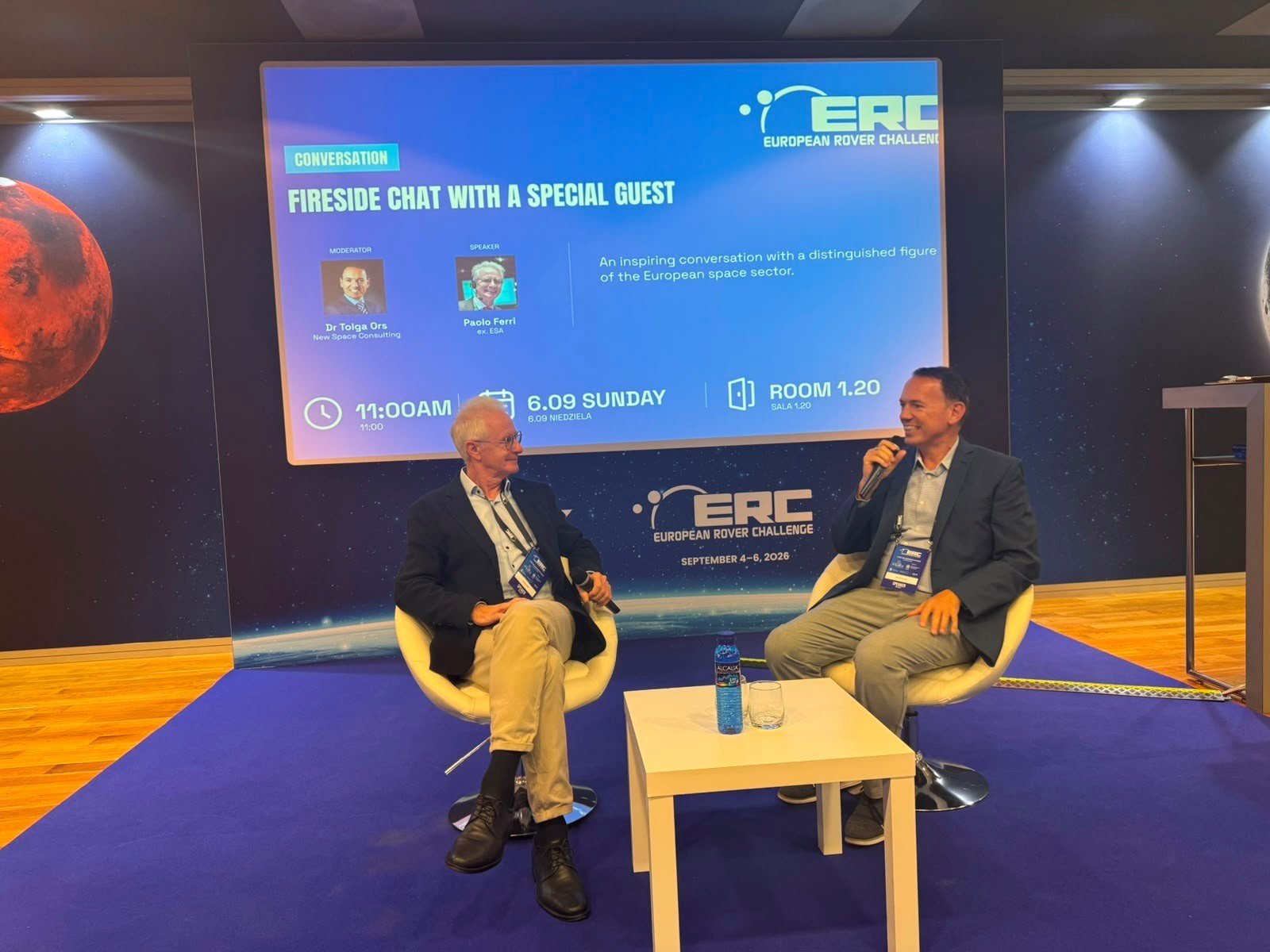
The highlight for me was a fireside chat with Paolo Ferri, retired Head of Space Operations at ESA, exploring the world of spacecraft operations. Most space sector presentations cover upstream (building things) or downstream (using the space data). Very few talk about the midstream: operating the spacecraft. Yet the operational phase of a mission is usually longer than the design and implementation phase I typically manage, which ends at handover to operations. Paolo’s point was clear: mission design must take operations requirements into account from the start. He also informed us that a good spacecraft operations resource will need to have a good understanding in a wide variety of fields: space operations is a true system engineering job. We touched on how ML and AI could support space mission operations in the future. Help in anomaly detection in telemetry is already a reality, but this could be extended in the future to autonomous commanding activities. We also talked about his books, one of which is about the Rosetta mission, whose operations he led over two decades. A refreshing change of perspective.
I then presented on commercial New Space, starting with the differences between traditional and New Space. My view, based on my years at Intelsat, Inmarsat and CGI, is that traditional space companies are more risk averse, with a more advanced risk management framework. Some ESA attendees pushed back on that. Healthy debate.
From there I mapped the NewSpace landscape: the established sectors (Satcom, EO and GNSS), the up and coming ones (microgravity manufacturing among others) and future areas such as space resources. To size the market, I drew on the ESA Report on the Space Economy 2026. The global upstream market stands at 75 billion euro, growing at 20%, split 78% manufacturing and 22% launch. The global downstream market is 489 billion euro, growing at 7%.
Then there is the Polish context, which changed significantly this year. At the ministerial, the country increased its ESA contribution from 194 million euro to 731 million euro. That is a step change, and it is why I also covered the growth of Polish New Space and the new Civil Security and Resilience Centre to be established in Warsaw. This level of investment means real opportunities for Polish NewSpace startups.
Thanks to Lukasz Wilczynski, an amazing host, and to Małgorzata, Magdalena and others for the behind the scenes magic. Next year Lukasz is leading the organization of IAC 2027 in Poznan, the largest space gathering of the year, so the ERC may skip a year.
ESA report on the space economy
https://www.esa.int/About_Us/Business_with_ESA/ESA_releases_2026_Space_Economy_Report
Poland’s ESA Contributions Surge to €731 Million: Warsaw to Host New Civil Security and Resilience Centre
ERC website