The European Space Agency – ESA Space Rider program represents a significant step forward in Europe’s capabilities in space transportation and reusable spacecraft technology. Designed to offer a platform for experiments and technology testing in space, Space Rider will provide European industries and researchers with access to space environments while also reducing the cost of missions through its reusable design.
ESA has now achieved a crucial milestone as Space Rider successfully completed critical drop tests in Sardinia. These tests mark a pivotal step toward operational deployment of Europe’s first reusable orbital vehicle, bringing the promise of democratized access to space-based research closer to reality.
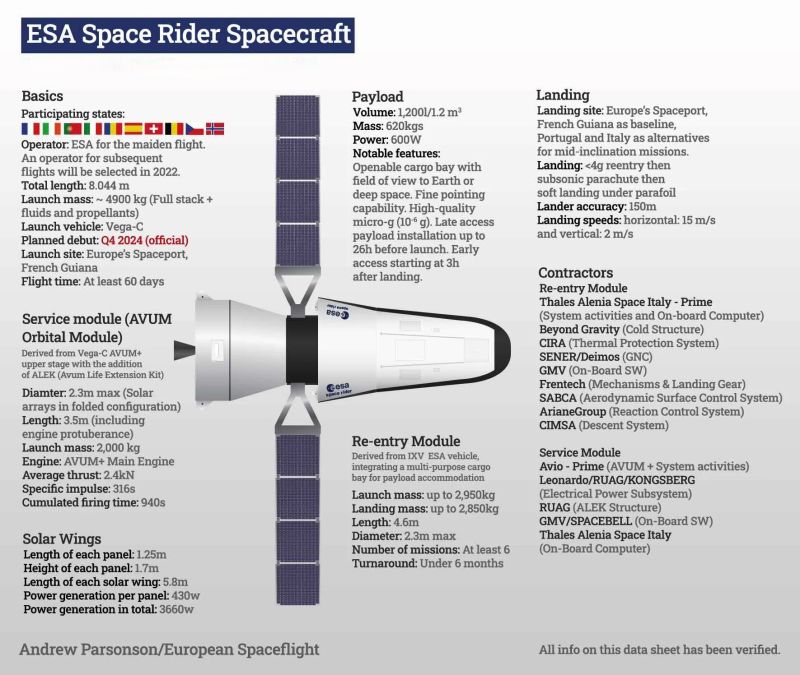
Space Rider is an unmanned, reusable spacecraft being developed for in-orbit experimentation and technology demonstration. The vehicle can remain in orbit for up to three months before returning to Earth, completing a precision landing under a parasail for recovery and reuse. The spacecraft consists of two main components: the reusable Re-entry Module, primed by Thales Alenia Space, and the expendable Service Module, primed by AVIO, that provides orbital maneuvering capabilities.
During recent trials in Sardinia, Space Rider’s autonomous landing systems demonstrated precision that becomes essential for its operational mission profile. Test platforms dropped from 2.5 kilometers by Italian Army helicopters achieved landing accuracy within 150 meters of their targets—a world-first achievement for parafoil-guided systems. This precision matters when considering that Space Rider will endure re-entry temperatures exceeding 1,600°C while traveling at six times the speed of sound before executing its autonomous descent, with the spacecraft’s sophisticated parachute sequence.
Space Rider addresses a fundamental challenge in European space capabilities—providing cost-effective, repeated access to microgravity environments. With its 600-kilogram payload capacity and ability to return experiments intact to Earth, the spacecraft opens new possibilities for materials science, biological research, and technology validation that traditional missions cannot offer.
After each mission, Space Rider requires six months of refurbishment before returning to service, significantly reducing costs compared to disposable systems while supporting extended orbital missions.
As Space Rider approaches its maiden flight aboard the Vega-C rocket in 2027, the program exemplifies the strength of European industrial collaboration. Different companies from different countries are providing specialized components and systems as illustrated in the below figure.
ESA’s Space Rider Reusable Spacecraft Nears Operational Reality