


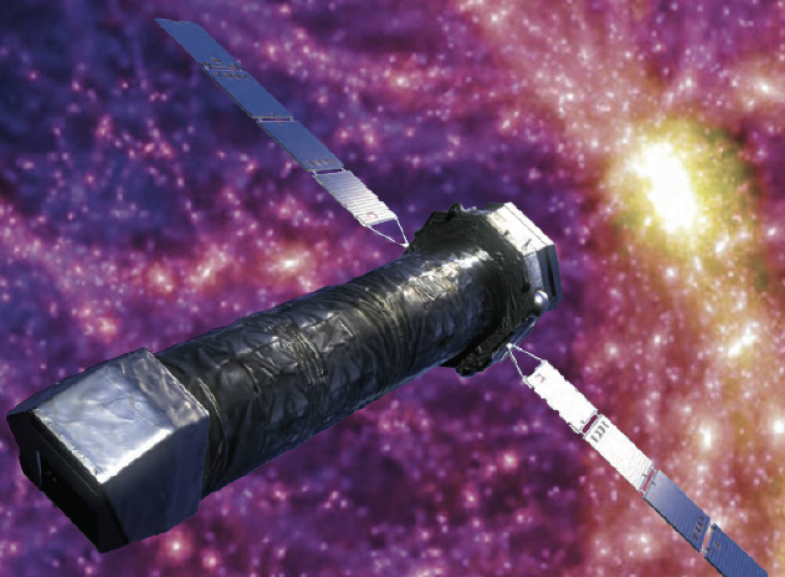
ESA’s Science Programme Committee (SPC) endorsed a rescoped version of the Athena X-ray observatory. The SPC has recognized that New ATHENA, as a flagship mission of the ESA Science Program, will transform our knowledge in almost every corner of modern astrophysics. This achievement has been the result of a year-long collective design effort by ESA, the Instrument Consortia, and the Science Redefinition Team (SRDT) with the active participation of many members of the ATHENA community.
The Advanced Telescope for High ENergy Astrophysics (ATHENA) represents a significant leap forward in X-ray astronomy. Selected by the European Space Agency (ESA) as part of its Cosmic Vision programme, ATHENA promises to be a observatory that will address fundamental questions about the Hot and Energetic Universe.
The Hot and Energetic Universe encompasses the most extreme and powerful phenomena in our cosmos. It includes the vast reservoirs of hot gas permeating galaxy clusters, the supermassive black holes at the hearts of galaxies, and the intense radiation from quasars and gamma-ray bursts.
ATHENA’s unique capabilities stem from its innovative design. The observatory features a large-aperture grazing-incidence X-ray telescope with a 12-meter focal length, utilizing high-performance silicon pore optics developed in Europe. This cutting-edge technology enables ATHENA to achieve an unprecedented combination of collecting area, survey capabilities, and energy resolution.
The observatory’s focal plane houses two state-of-the-art instruments. The Wide Field Imager (WFI) will provide sensitive wide-field imaging and spectroscopy, along with high count-rate capability. Complementing this, the X-ray Integral Field Unit (X-IFU) will deliver spatially resolved high-resolution X-ray spectroscopy over a field of view spanning several arcminutes.
ATHENA’s versatility as an open observatory will allow it to tackle a wide range of astrophysical phenomena. From probing the nature of black holes and neutron stars to studying the hot gas in galaxy clusters and exploring the interstellar medium, ATHENA will provide insights across numerous areas of research.
The mission’s capabilities extend beyond traditional X-ray astronomy. ATHENA is poised to make significant contributions to multi-messenger astrophysics, working in synergy with gravitational wave detectors and neutrino observatories. This collaborative approach will open new avenues for understanding some of the most energetic and mysterious events in the universe.