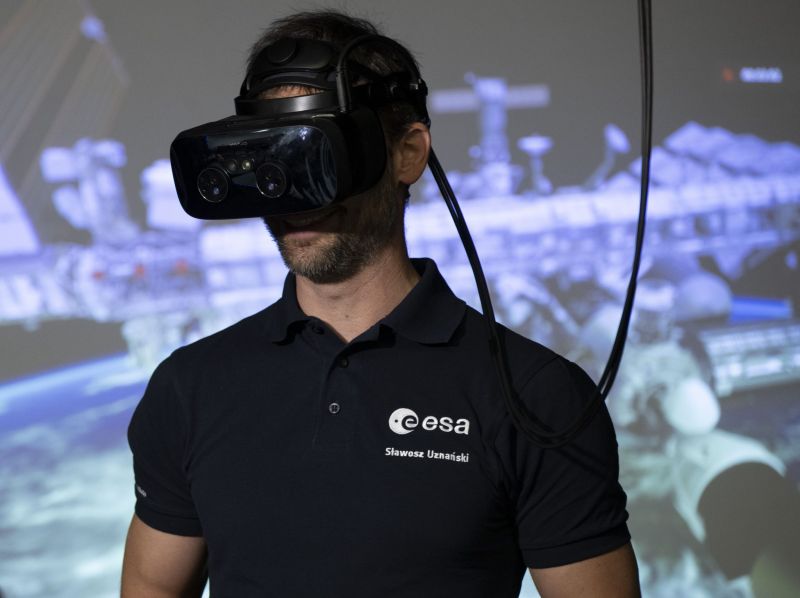
The European Space Agency – ESA Artificial Intelligence Laboratory for Human and Robotic Space Missions is working to integrate AI across space operations, from astronaut training to autonomous systems deployment. Based at the European Astronaut Centre in Cologne, the facility focuses on developing practical applications while carefully considering the limitations of current AI paradigm.
Despite advances in AI development, fundamental challenges persist: ensuring robust performance in complex, changing environments, managing edge cases, and meeting the rigorous safety standards required for space missions. These limitations must be carefully considered when using AI for space applications.
The Lab’s work addresses specific operational challenges in space exploration, particularly the need for autonomous decision-making in environments where real-time communication with Earth isn’t feasible. Space exploration poses unique hurdles, from harsh environmental conditions to strict size, weight, and power constraints. The current big-data AI paradigm requires high-performance processors, but these must be adapted to survive radiation and extreme temperatures. ESA collaborates with industry partners to develop resilient, compact, and energy-efficient AI hardware for space missions. An alternative path would be to use NeuroAI solutions which do require less energy and processing power.
Current projects include the integration of AI with eXtended Reality (XR) technologies for astronaut training. Digital twins – virtual representations of spacecraft and mission environments – help teams refine mission planning and manage risks. On the International Space Station (ISS) , the Lab is testing Large Language Models (LLMs) to improve access to technical documentation for flight controllers. The limitation of LLMs is that they are not known to be accurate as they store statistical representation of information instead of information itself. There is therefore always a risk that inaccurate information will be provided.
Looking toward future missions, the Lab is developing AI systems with enhanced autonomous capabilities for Moon surface missions and the Rosalind Franklin Mars rover. The Lab’s work illustrates the potential of AI in space exploration. While AI offers promising solutions for specific challenges, successful implementation requires careful consideration of the limitations of AI, safety requirements, and the need for reliable operation in extreme environments.
ESA’s AI Lab Develops AI Applications for Space Exploration: Balancing Potential with Technology Limitations