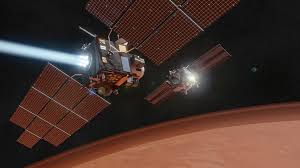
European Space Agency – ESA is preparing to transform how we reach and study Mars with LightShip, a reusable electric propulsive tug designed to deliver spacecraft to the Red Planet while providing essential communication and navigation services. By inviting European industry and New Space startups into the payload selection process, ESA is democratizing access to interplanetary missions.
The MARCONI (MARs COmmunication and Navigation Infrastructure) payload aboard LightShip addresses two critical barriers that typically make Mars missions prohibitively expensive: reliable communication and navigation. From its dedicated service orbit, MARCONI provides data relay infrastructure between Mars surface missions and Earth, while initiating development of Mars’ first navigation satellite system. This shared capability eliminates the need for each mission to incorporate comprehensive communication systems, reducing complexity, mass, and cost.
🛰️ On its first mission, LightShip will carry Spotlight, a spacecraft that will detach in Mars orbit and begin its scientific mission. While Spotlight enters its Passenger Operational Orbit, LightShip remains in a dedicated orbit for MARCONI, operating its own scientific payload suite.
🌌 Two spacecraft, two orbits, two sets of science goals.
🔬 The LightShip Instrument Definition Team (IDT) completed its report at the end of 2024, identifying core science themes:
– Atmospheric circulation & dynamics
– Dust storms & the Martian dust cycle
– Water cycle, clouds & chemistry
– Enabling safer Mars exploration
💡 There’s an exciting opportunity for industry to propose payloads that align with these goals. Considered instruments include sub-mm sounders, IR mappers, imaging suites, and dust monitors.
💰 With its cost-effective electric propulsion and ability to carry up to 12 passenger spacecraft, LightShip could enable frequent, lower-cost access to Mars, perfect for emerging players like Team Tumbleweed and their swarm of rovers.
📅 The programme’s future will be decided at the ESA Council at Ministerial Level in November 2025, with the first launch possible by 2032.
Mars exploration continues to evolve toward modular, sustainable, and collaborative approaches. LightShip represents more than transport – it functions as a shared platform that levels the playing field for the next wave of space innovators. Through Announcements of Opportunity and dedicated industry partnerships, ESA is nurturing a new ecosystem where established aerospace firms and New Space startups collaborate to expand humanity’s presence on the Red Planet.
🚀 ESA’s LightShip: A New Era of Mars Exploration