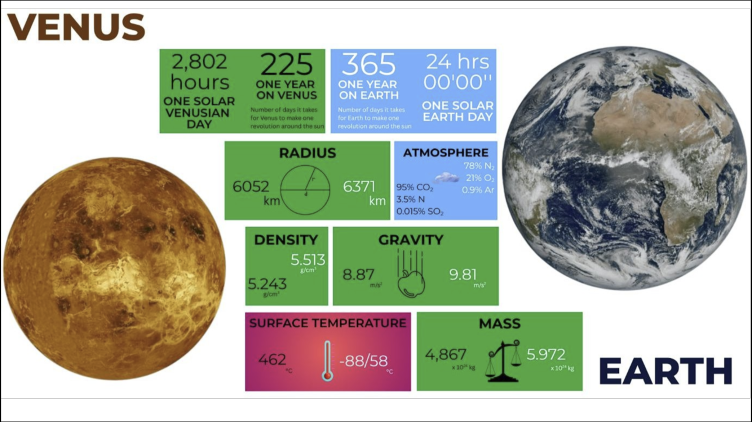
Interest in Venus has surged in recent years, as scientists increasingly recognize the need for a modern, comprehensive study of our planetary neighbor Venus—the first of its kind since NASA’s Magellan mission in the 1990s.
Magellan, launched aboard Space Shuttle Atlantis in May 1989, arrived at Venus after a 15- month journey. The mission was named after explorer Ferdinand Magellan, and it was the first spacecraft to image the entire Venusian surface and made several key discoveries about the planet’s geology and atmosphere.
Despite having a similar size and mass to Earth, Venus presents a completely different story. With a scorching surface temperature of 462°C and an atmospheric pressure 92 times that of Earth’s, Venus has long fascinated scientists. While the interplay between Earth’s internal processes such as plate tectonics, earthquakes, and volcanism are relatively well understood, Venus shows signs of volcanic activity without any confirmed evidence of plate tectonics. The central mystery is this: Why did Venus evolve so differently from Earth, despite their apparent similarities in size, mass, and composition?
To answer these questions, the European Space Agency – ESA is planning to launch EnVision in November 2031. The contract was awarded to Thales Alenia Space to build a low- altitude polar orbiting spacecraft designed to investigate Venus from its inner core to upper atmosphere. EnVision aims to uncover how and why Earth and Venus, even though so alike in many ways, took radically different evolutionary paths. Magellan and Venus Express missions revealed a complex and dynamic planet, but the full story is still missing or yet to be told.
EnVision is equipped with the following instruments which will provide a comprehensive view of Venus’ surface, atmosphere, and interior.
1. VenSAR – Venus Synthetic Aperture Radar
VenSAR is the mission’s primary radar instrument provided by NASA – National Aeronautics and Space Administration.
2. VenSpec Suite – Three Specialized Spectrometers
2.1 VenSpec-U (Ultraviolet Spectrometer) by LATMOS, IPSL
2.2 VenSpec-H (High-Resolution Infrared Spectrometer) by Royal Belgian Institute for Space Aeronomy
2.3 VenSpec-M (Infrared Mapper) by German Aerospace Center (DLR)
3. SRS – Subsurface Radar Sounder by Università di Trento
4. Radio Science Experiment by Nantes Université
EnVision will investigate the fundamental question of what caused our most Earth-like neighbor to evolve so drastically differently from our home planet. By studying Venus’ unique evolutionary path, the mission will provide crucial insights into the conditions necessary for planet formation and the emergence of life, while advancing our broader understanding of how planetary systems develop and function throughout the cosmos.
ESA EnVision Mission to Explore our Planetary Neighbor Venus