


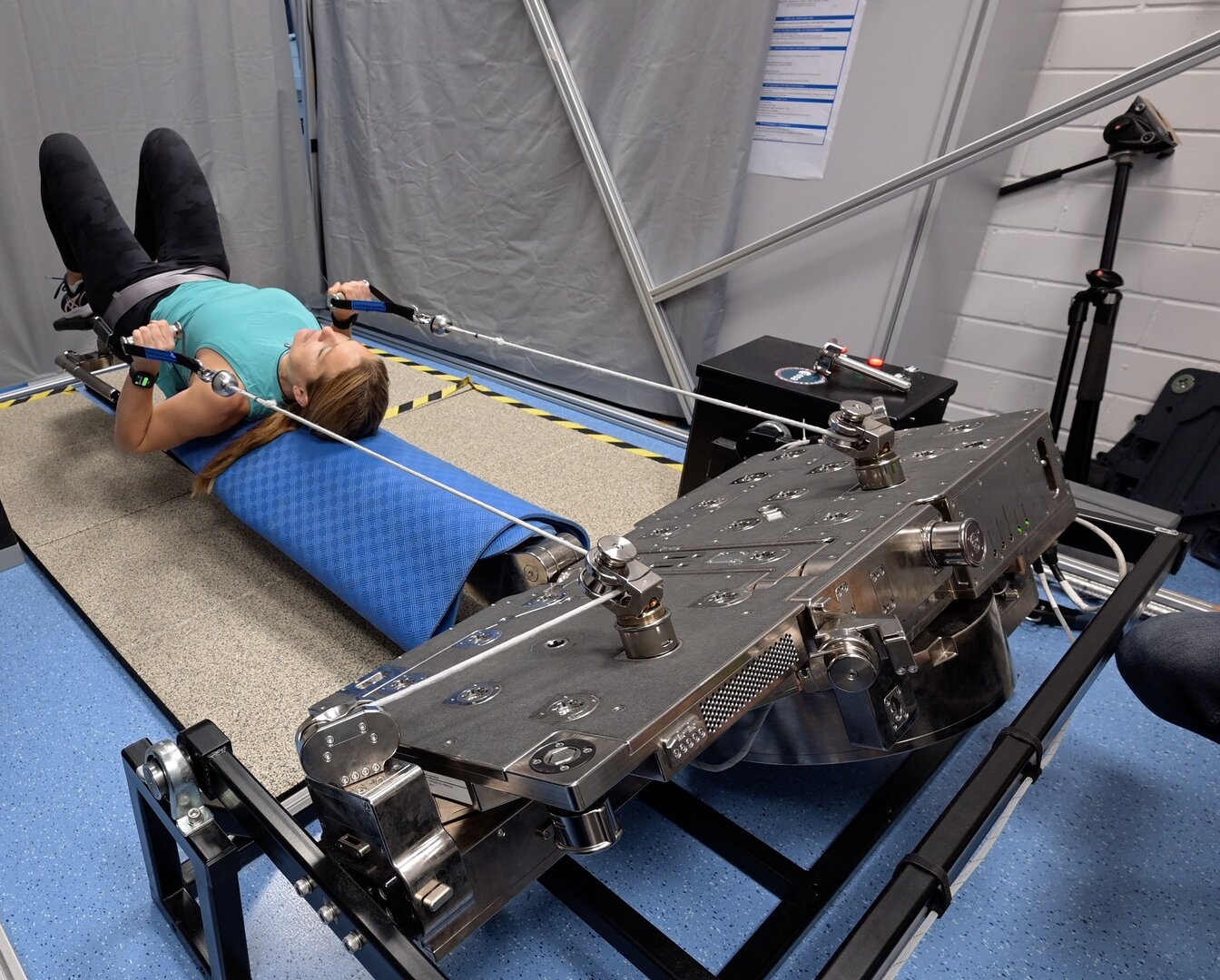
As humanity prepares for exploration beyond Earth orbit, maintaining physical health in microgravity remains a primary concern. Without rigorous daily exercise, astronauts face significant physiological challenges, including muscle atrophy, bone loss, and reduced coordination—health issues that can occur even on the International Space Station, as the recent evacuation has demonstrated.
Current exercise systems used on the ISS are too heavy and bulky for the strict space constraints of future missions, such as the Lunar Gateway. The European Space Agency commissioned the European Enhanced Exploration Exercise Device (E4D) as a lightweight, more compact exercise module, developed by the Danish Aerospace Company with motion capture technology from Qinematic.
Versatile Training Capabilities
E4D provides a compact solution by combining four exercise modes: resistance training, cycling, rowing, and rope pulling. It supports loads up to 270 kg and can adjust effort during lifting or lowering phases, making workouts harder or easier as needed. The cycling feature offers power-based resistance for a realistic experience, while the rope-pulling tool prepares astronauts for emergency scenarios, such as moving an incapacitated crew member.
Motion Capture Innovation
A key innovation is E4D’s motion capture system, which ensures safe training and injury prevention. Four cameras installed in Columbus track astronaut movements, identify anatomical landmarks, and send real-time data to Earth. Astronauts see themselves as an avatar on a tablet for posture correction, while plug-and-play artificial intelligence instantly recognizes body parts and transmits data for analysis.
Future upgrades could integrate machine learning and virtual reality, allowing participants to use VR headsets to share the same virtual space as their crewmember, even while separated by thousands of kilometers between Earth and space. By comparing space-based data with ground tests, E4D also functions as a research platform to optimize health countermeasures for deep space.
Path Forward
Scheduled to arrive on the ISS in April 2026, E4D will undergo installation followed by a technology demonstration phase where crew members will test up to 100 exercise variations. The data collected from this ESA payload will guide development of an even more advanced next-generation system. As humanity ventures deeper into the solar system, innovations like E4D represent an important step toward maintaining astronaut health and performance on increasingly longer missions.
Image credit: European Space Agency (ESA)
References
Revolutionising astronaut fitness for deep space missions
E4D Product
https://www.danishaerospace.com/en/work/products/e4d
Qinematic website