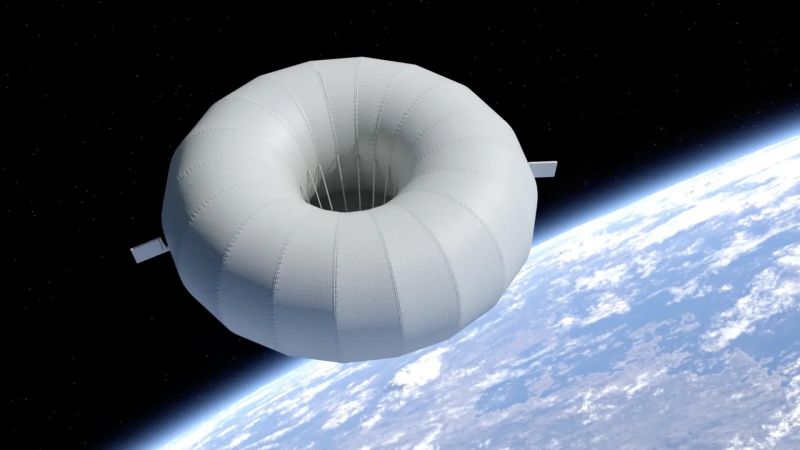
After receiving crucial payload review approval from the Federal Aviation Administration (FAA), German New Space company ATMOS Space Cargo is set to make European private spaceflight history. The company’s Phoenix capsule, equipped with an innovative inflatable heat shield system, will demonstrate re-entry capabilities during its maiden flight aboard SpaceX‘s Bandwagon-3 rideshare mission this April.
This milestone positions ATMOS within a growing commercial space ecosystem focused on payload return capabilities. The Phoenix-1 prototype capsule’s 100-kilogram capacity, coupled with its scalable architecture supporting potential multi-ton returns, addresses emerging needs across biotech, space manufacturing, and rapid cargo delivery sectors.
The mission architecture integrates multiple international payloads, including a radiation monitor from the German Aerospace Center (DLR) and biotech experiments from Japan’s IDDK Co., Ltd. and the UK’s Frontier Space. Phoenix will conduct a carefully orchestrated three-hour mission culminating in a controlled reentry over the Indian Ocean. The mission is expected to conclude with the prototype’s loss during re-entry, providing valuable data for the next iteration of this platform – the Phoenix 2 capsule.
There are three core objectives for the prototype’s test flight:
1. Collecting in-flight data from the capsule and sub-components in orbit.
2. Gathering scientific data from customer payloads carrying technology demonstrators and biological experiments.
3. Successfully deploying and stabilizing the Inflatable Heat Shield during atmospheric re-entry.
The timing coincides with increased activity in the space cargo return sector, as companies like Inversion and Varda Space Industries advance their own reentry systems. Sebastian Klaus, CEO and co-founder of ATMOS Space Cargo, notes their focus on larger-scale returns: “The first-generation vehicle demonstrates 100 kilograms of capacity, with clear scaling potential to several tons.” The company is already developing an enhanced larger Phoenix spacecraft capable of extended orbital operations, projected for launch within a year.
ATMOS’ rapid progress, from securing 5.3 million euro in funding to obtaining FAA regulatory approval, demonstrates that European New Space companies can successfully navigate both technical and regulatory challenges on the global stage. As the commercial space sector advances, the company’s achievement shows that innovation and market access in the expanding space economy transcend geographical boundaries
Image Credit: Atmos Space Cargo – Phoenix, a reentry spacecraft that uses an inflatable heat shield.
ATMOS Space Cargo To Become First European Private Company to Attempt Space Re-Entry