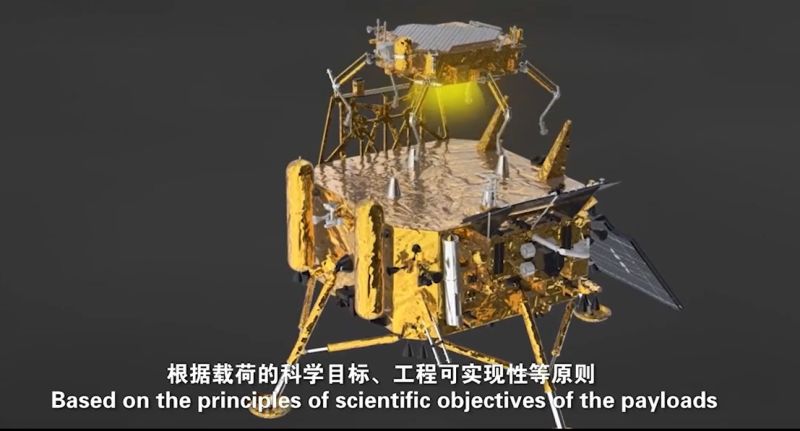
China’s lunar exploration program advances with the planned Chang’e-7 mission, scheduled for 2026. The mission features an innovative mini flying probe designed to explore previously inaccessible regions of the Moon’s south pole in search of ice. The payload details including for the lander and rover are described in 2 journal publications [1,2].
The mission addresses a persistent challenge in lunar exploration: accessing permanently shadowed regions at the bottom of deep impact craters. These areas, perpetually dark due to the low angle of sunlight and the shadowing effect of crater walls, may harbor valuable water ice deposits crucial for future lunar missions.
Traditional rovers face physical limitations in reaching these depths. To overcome this, Chinese engineers developed a mini flying probe with active shock-absorption technology for safe landings. The probe carries the Lunar Soil Water Molecule Analyzer (LSWMA), which combines a gas acquisition unit, mass spectrometer, and physical property sensor to analyze water molecules and hydrogen isotopes at the source.
The probe will launch from illuminated areas before navigating to shadowed crater depths, where it will deploy a drilling tool to collect samples. A mechanical arm will transfer these samples to a heating furnace for detailed spectral analysis, providing direct evidence of water presence.
This advancement in lunar exploration technology serves a broader scientific purpose. Understanding lunar ice distribution remains fundamental for establishing a sustained human presence on the Moon. If present in sufficient quantities, this ice could enable life support systems and fuel production. The mini flying probe’s mission represents a crucial step in validating these resources for long-term lunar operations
Image Credit: From China National Space Administration (CNSA) presentation of Chang’e-7 payload. Screenshot of mission lander and flying mini-probe [3].
Advancing Lunar Resource Detection: China’s Flying Mini Probe to Explore Moon’s Dark Craters