The NASA-ESA Mars Sample Return mission represents one of the 21st century’s most ambitious scientific undertakings, with the fundamental challenge of preserving pristine Martian samples during their journey to Earth. The Perseverance Rover has already collected these precious samples on Mars, which are now stored in sealed titanium tubes awaiting their historic journey back to Earth.
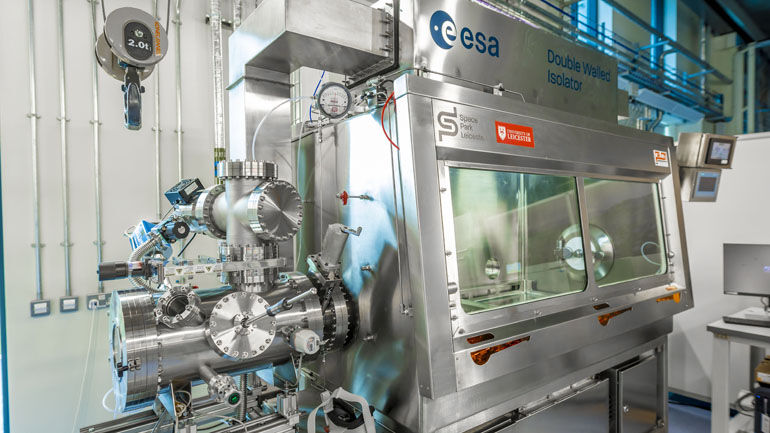
The European Space Agency – ESA funded and University of Leicester built Double Walled Isolator (DWI) is a critical component for this mission, designed to protect both the samples from terrestrial contamination and Earth’s environment from potential hazards. Contamination of samples is possible, as demonstrated by recent experiences with asteroid Ryugu samples, where terrestrial microorganisms were detected despite strict protocols.
Returning samples to Earth, rather than analysing them on Mars, enables international expert scientists to employ state-of-the-art instruments too large and complex for Mars-based analysis. The DWI provides a controlled pristine environment for basic characterization operations, functioning as an ultra-clean, class III bio-safety cabinet that offers BioSafety Level 4 (BSL-4) containment. BSL-4 is the highest level of biosafety precautions.
The DWI incorporates sophisticated features, including an Interface Flange that allows scientific instruments such as optical instruments and spectrometers to access the working volume while maintaining double seal isolation. This enables some testing of the samples before their arrival back to Earth. A Rapid Transfer Port enables contained safe transfer of samples in and out of DWI, ensuring the integrity of both the samples and our terrestrial environment.
As NASA and ESA revise the Mars Sample Return mission, solutions like the DWI are essential in our quest to bring back samples from the red planet while avoiding any contamination of these samples.
Advanced Containment Technology for Mars Sample Return: The Double Walled Isolator