


Global Navigation Satellite System (GNSS) technology like GPS has become fundamental to modern navigation, yet its vulnerability to interference and jamming reveals a critical gap in our navigation infrastructure. This challenge is driving research into quantum inertial sensors based on cold atoms, a technology that could transform how we navigate both on Earth and in space.
Unlike classical Inertial Measurement Units (IMUs), quantum sensors based on cold-atom interferometry provide absolute measurements that do not drift over time. This enables truly autonomous navigation independent of external signals, naturally resilient to jamming or spoofing.
NASA’s Cold Atom Lab aboard the International Space Station advances quantum sensing by creating Bose-Einstein Condensates, chilling atoms to fractions of a degree above absolute zero to make quantum behaviors observable at macroscopic scales. While such extreme cooling can be achieved in Earth-based laboratories, the space environment offers a distinct advantage: microgravity. On Earth, ultracold atoms immediately begin falling due to gravity, limiting observation windows to milliseconds. Aboard the ISS, atoms remain suspended without gravitational pull, extending measurement periods to several seconds. This allows quantum superposition in cold-atom interferometers to persist far longer, translating to sensitivity levels several orders of magnitude higher than classical devices, particularly for long-wavelength measurements. The research enables extremely sensitive gyroscopes using cold atoms to detect minute rotations, potentially revolutionizing space-based navigation.
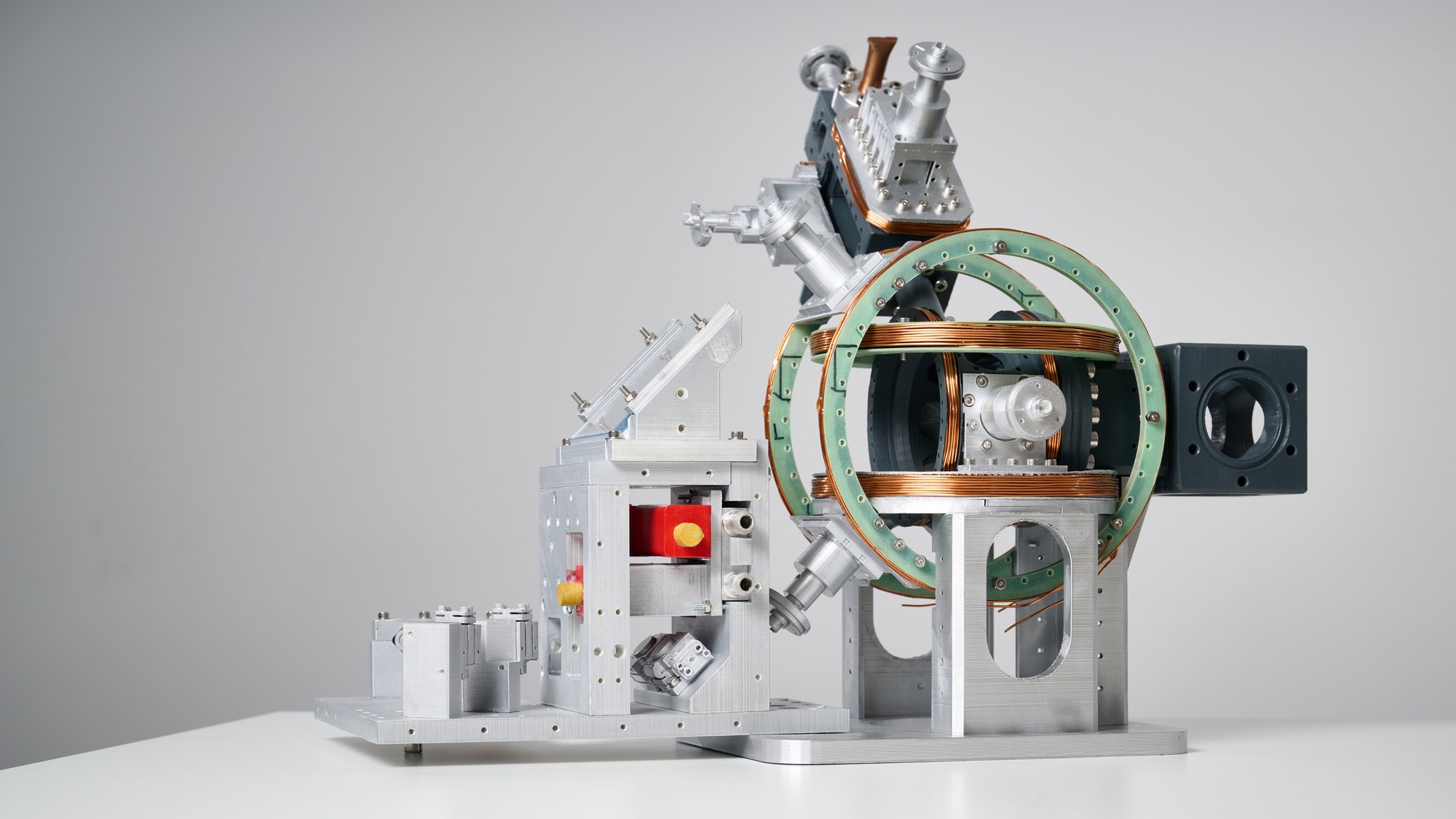
Despite rapid progress, quantum navigation technology currently holds a low Technology Readiness Level (TRL) for operational space deployment at full performance potential. The upcoming Cold Atom Rubidium Interferometer in Orbit for Quantum Accelerometry (CARIOQA) mission aims to demonstrate quantum accelerometers in true space conditions, while the NASA-DLR Bose-Einstein Condensate and Cold Atom Laboratory (BECCAL) lab will further expand cold-atom research on the ISS to increase the TRL for deep-space operations.
Drift-free quantum accelerometers represent a rapidly advancing technology with strong potential to enable fully autonomous navigation systems. These sensors could significantly enhance the resilience of navigation both on Earth and in Space by reducing reliance on external signals and improving operational robustness across a wide range of environments.
Image Credit: DLR – BECCAL experiment
References:
CARIOQA project info
Bose Einstein Condensates & Cold Atoms Lab
BECCAL – developing technologies for quantum sensors in space
https://www.dlr.de/en/research-and-transfer/projects-and-missions/beccal