


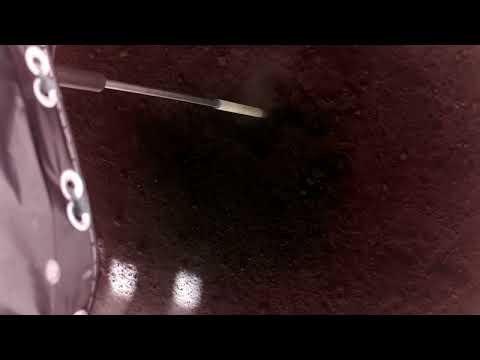
The exploration of our lunar neighbour continues to advance through innovative instrumentation designed to unlock the Moon’s geological secrets. Among these is LISTER (Lunar Instrumentation for Subsurface Thermal Exploration with Rapidity), currently operating aboard Firefly Aerospace‘s Blue Ghost lunar lander.
LISTER represents a collaborative achievement between Texas Tech University and Honeybee Robotics, a Blue Origin Company. This specialized thermal probe measures critical heat flow parameters from the Moon’s interior, providing valuable insights into lunar thermal flows. Note that this is the deepest-reaching (up to 3m) planetary subsurface thermal probe ever deployed outside Earth.
The instrumentation operates through a sophisticated pneumatic drilling system capable of penetrating more than two meters into the lunar regolith. At half-meter intervals, the system pauses to extend custom-built thermal probes that measure two crucial parameters: thermal gradient (temperature variations at different depths) and thermal conductivity (how effectively subsurface materials transmit heat). The product of these measurements yields the lunar heat flow—a fundamental value for understanding the Moon’s geological development.
“By making similar measurements at multiple locations on the lunar surface, we can reconstruct the thermal evolution of the Moon,” explains Dr. Seiichi Nagihara, geophysics professor at Texas Tech. “That will permit scientists to retrace the geological processes that shaped the Moon from its start as a ball of molten rock, which gradually cooled off by releasing its internal heat into space.”
As one of ten NASA – National Aeronautics and Space Administration Commercial Lunar Payload Services (CLPS) commissioned Firefly Aerospace Blue Ghost lander payloads, LISTER contributes to the broader scientific foundation supporting NASA’s Artemis campaign for establishing a sustainable lunar presence. The knowledge gained through these subsurface investigations helps scientists and engineers develop more informed approaches to long-term lunar habitation.
This collaboration between NASA, academia and New Space companies demonstrates the potential of public-private partnerships in advancing lunar exploration. The success of LISTER on the Blue Ghost mission opens doors for other companies to participate in lunar payload opportunities. As lunar missions become more frequent, opportunities expand for companies across sectors to contribute instruments, experiments, and innovations that address the challenges of sustained presence beyond Earth while generating valuable scientific data that enhances our understanding of the Moon and its resources. The Moon serves as just the beginning—a proving ground for technologies and methodologies that will eventually extend to other celestial bodies.
References
NASA Payload Aims to Probe Moon’s Depths to Study Heat Flow https://www.nasa.gov/missions/artemis/clps/nasa-payload-aims-to-probe-moons-depths-to-study-heat-flow/
Honeybee Selected to Send Two Payloads to the Moon https://www.honeybeerobotics.com/news-events/honeybee-selected-to-send-two-payloads-to-the-moon/
Watch Blue Ghost Test its Vacuum and Drill Experiments on the Moon https://www.universetoday.com/articles/watch-blue-ghost-test-its-vacuum-and-drill-experiments-on-the-moon
Blue Ghost Mission Operations Updates https://fireflyspace.com/news/blue-ghost-mission-1-live-updates/